Rotary tube furnaces provide an efficient way to transfer heat in a short amount of time and run batches of materials without interruption. These furnaces significantly reduce material handling in various use cases, including powder processing.
Multiple factors should be considered when deciding whether a rotary tube furnace is the ideal choice for a particular process. This article highlights these considerations while outlining the relevant products produced by Deltech.
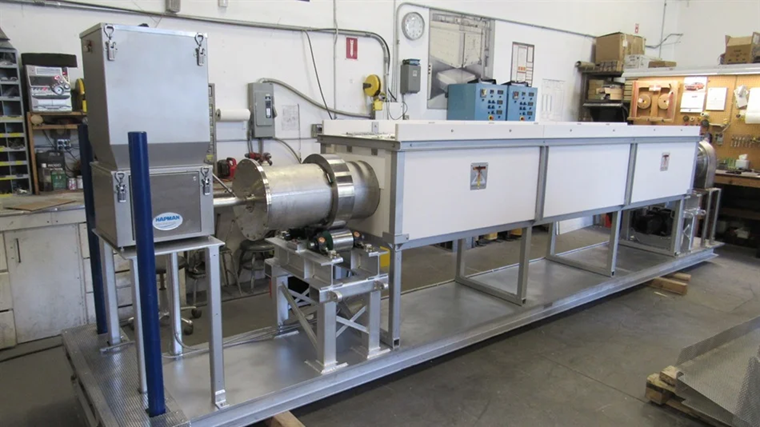
Image Credit: Deltech, Inc
Which Specifications Are Adjustable?
At Deltech, rotary tube furnaces are tailor-made to the unique requirements of each client. This level of customization means that regardless of use case, the customer is able to define their needs for a range of aspects, including:
- Temperature control: Operating temperatures reach up to 1700 °C
- Tube inclination angle
- Atmosphere flow rate
- Temperature profile
- Workspace size
- Residence time
- Tube rotation rate
- Powder bed depth
- Feed rate
Important Points to Bear in Mind When Choosing a Rotary Tube Furnace
When choosing a tube for a rotary tube furnace, several key parameters must be considered, including rotational speed, material quantity, tube diameter, suspended length, and tube thickness. Tube material is also crucial to consider as it may alter the potential use cases.
- Alloy tubes: Alloy tubes are ideal for tube diameters over nine inches, but they are limited to temperatures under 1260 °C.
- Ceramic tubes: Ceramic tubes are a more secure option when metals in the alloy may react to high-purity products or off-gases. They are needed for processing at high temperatures.
- Quartz tubes: Quartz tubes, although non-permeable, are only appropriate for use cases that involve temperatures under 1200 °C. An alumina coated quartz tube can be used at 1450 °C if the operation is continuous.
- Other tubes: Owing to their porous nature, lower-grade silicon carbide tubes and alumina oxide tubes are not suitable for use cases requiring processing in a controlled atmosphere.
What to Bear in Mind When Selecting a Furnace
Rotary tube furnaces are not made for every use case. For example, use cases that require long residence times need a slight inclination angle coupled with a slow tube rate, as controlling residence time for over two hours can be difficult.
If the product requires extended processing times, different furnace options, including bottom-load, front-load, or top-hat furnaces, may be recommended. These furnaces are complete with optional controlled-atmosphere abilities and provide a uniform temperature over long periods of time.
Deltech Furnaces
Deltech rotary tube furnaces are resistance-heated to the maximum required temperature, in accordance with other requirements and considerations. They make use of different kinds of heating elements, like wire-wound, silicon carbide, and moly disilicide.
As an ISO 9001:2015-certified company, Deltech ensures its control systems comply with the Intertek UL508A standards.

This information has been sourced, reviewed, and adapted from materials provided by Deltech, Inc.
For more information on this source, please visit Deltech, Inc.