This press release announces the findings from the initial batch of 17,000 samples, which cover an area of 189.3 sq. km (approximately 11.5 km by 18.2 km) situated on the western side of the Elemes Licence. The results from the remaining 14,000 samples, covering the eastern portion of the Elemes Licence, are anticipated to be available within the next 3 to 4 weeks.
The soil analysis was conducted utilizing a Portable X-ray fluorescence device ("pXRF"), a widely employed instrument for determining the elemental composition of samples. Due to the limited sampling area of the pXRF, the results presented in this release are considered "indicative" rather than fully quantitative regarding mineralization.
Despite this limitation, the results have revealed a substantial and coherent copper-in-soil anomaly, with copper concentrations exceeding 150 ppm. Background copper in the area is considered to be less than 20 ppm. This anomaly stretches over a remarkable distance of more than 8.8 km from north to south and extends to approximately 1.5 km in width from east to west. Notably, it connects the Quartzite_Gorka and Berezski East historical drilling areas, which are situated over 5 km apart. These areas have previously confirmed high-grade porphyry copper-gold mineralization starting at the surface.
The continuity of the copper soil anomaly strongly suggests that the Quartzite-Gorka and Berezski-East areas represent only a small part of a much larger porphyry copper-gold system.
Re-Assay of Historical Core: The Quartzite-Gorka and Berezski East areas were drilled between 2007 and 2010. All available drill-core have been re-logged in detail by Arras for lithology, structure, alteration, and mineralization. The mineralization seen at both locations is interpreted to be the upper part of a porphyry copper-gold mineralizing system. The mineralization comprises of sheeted and/or stockwork veining of quartz-magnetite “A” veins with minor chalcopyrite-bornite ± k-feldspar halos; magnetite-only “M” veins; and quartz-chalcopyrite veins. Locally disseminated patches of chalcopyrite, bornite and pyrite occur. Anhydrite veins and late epidote-carbonate veins are also observed. The host diorite intrusion is fine-grained, equigranular and typically highly magnetic. Strong potassic (k-feldspar-quartz-magnetite-secondary biotite) alteration of the host diorite has been variably overprinted by intermediate argillic (illite-chlorite) alteration.
Arras also sent 6 holes, three each from Quartzite-Gorka and Berezski-East for re-assay. The summarized results of these re-assays are provided in Table 1 below and were disclosed in news releases on January 8, 2024, and January 22, 2024, respectively. Notably, the findings showcased zones of exceptionally high-grade mineralization, including sections measuring 30.8 meters grading 2.21% CuEq and 62 meters grading 1.53% CuEq.
Table 1. Summary table for the re-assay of historical drill holes for Quartzite-Gorka and Berezski-East
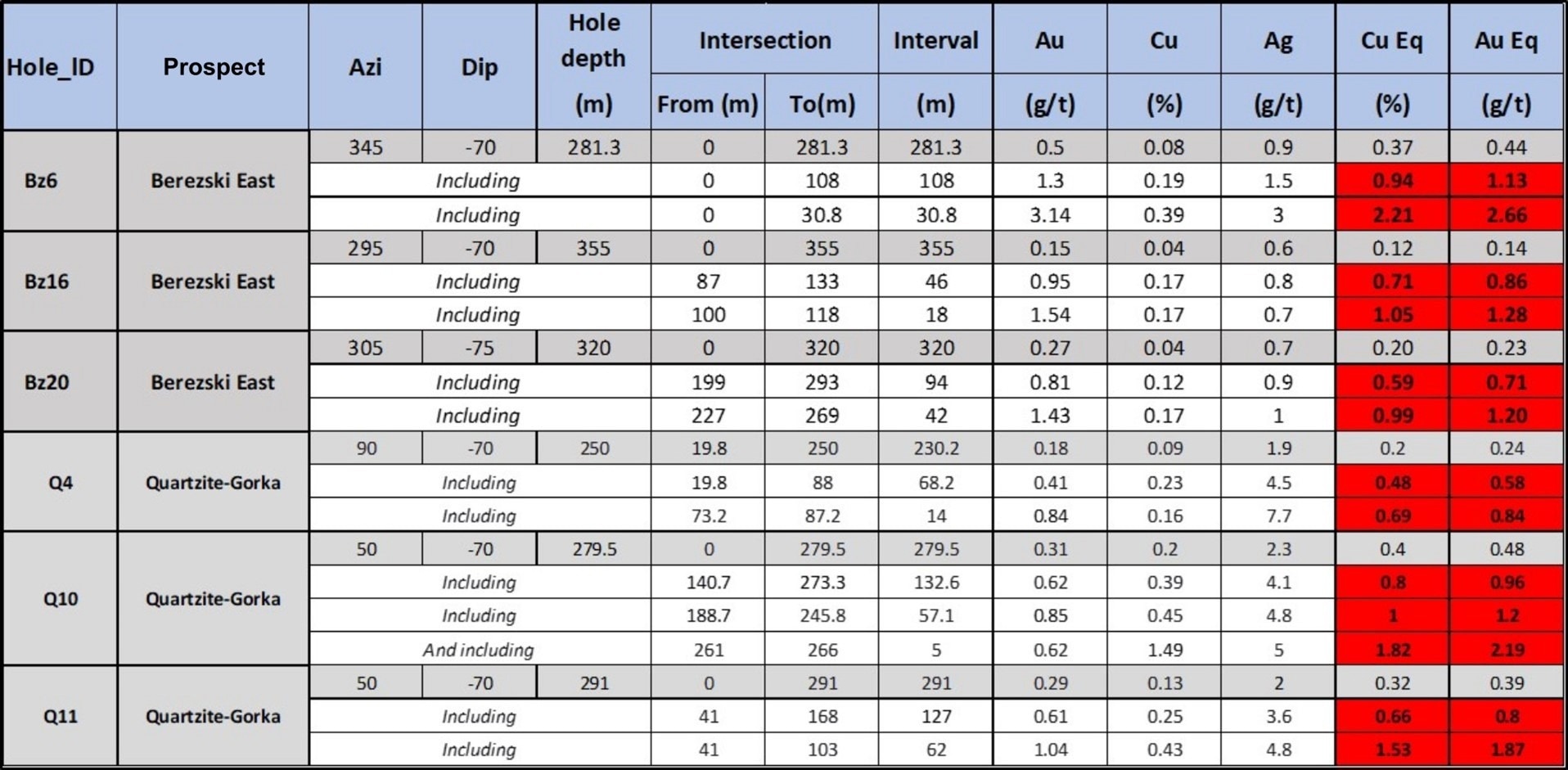
Notes: Copper Equivalent (“CuEq”) grades reported for the drill holes at Quartzite Gorka were calculated using the following formula: CuEq % = Copper (%) + (Gold (g/t) x 0.8264) + (Silver (g/t) x 0.0107) + (Molybdenum (ppm) x 6.0000). Gold Equivalent (“AuEq”) grades reported for the drill holes at Quartzite Gorka were calculated using the following formula: AuEq g/t = Gold (g/t) + (Copper (%) x 1.2100) + (Silver (g/t) x 0.0129) + (Molybdenum (ppm) x 4.0334). Assumptions used for the copper and gold equivalent calculations were metal prices of US$3.00/lb. Copper, US$1,700/oz Gold, US$22/oz Silver, US$18/lb. Molybdenum, and metallurgical recoveries were assumed to be 90% for Cu and Au and 50% for Ag and Mo. Intervals are core-length weighted and original core recovery is estimated to be > 90 %.
The Berezski Target: is located within the 425 square km Elemes mineral exploration licence. The Licence benefits from excellent modern infrastructure and ease of accessibility, being located only 20 km from Arras’ operational base in the city of Ekibastuz, northeastern Kazakhstan. A paved highway runs through the licence, and within 1 km of the Berezski target. 1100 KVA power lines and heavy rail all lie within a 15 km radius of the project.
The Berezski target is located within the Bozshakol-Chingiz metallogenic belt that also hosts the Beskauga porphyry copper-gold-silver project approximately 80 km to the east, and KAZ Minerals’ Bozshakol porphyry copper-gold mine (www.kazminerals.com) approximately 60 km to the northwest.
Sampling Methodology
Samples were collected on a 50m (East-west) by 200m (north-south) grid spacings. Samples were collected from hand-dug pits, trying to consistently sample the B horizon. Approximately 500 grams of material was collected and sieved (5mm mesh size) to review larger particles and organic matter. Following collection, the samples were bagged, dried, and analyzed by the company with a Portable Niton XL5 X-ray fluorescence analyzer at the company’s core storage facility in Ekibastuz.
Assay, QAQC Procedures:
Analysis was conducted using the company’s two Niton XL5 portable XRF units. Units were calibrated at the start and end of each work shift as well as after every 100 samples to verify accuracy. In addition, a measurement from a certified reference material was taken every 20 measurements to ensure accuracy and repeatability of data. In addition, prior to commencement of the measurements, 100 duplicate samples were analyzed using both units to confirm that both units were producing accurate results and that no bias was present in either of the units.
All soil material is stored at Arras’ warehouse in Ekibastuz, and the company plans to send a proportion of these samples to ALS Chemex in Karaganda, Kazakhstan for reanalysis with a 4-acid digest ICP-MS61 analysis and for trace gold analysis (using Au-ST43).