In this interview, industry expert Tom Strombotne explains how real-time XRF slurry analysis supports faster process control, multi-element measurement, and safer isotope-free operation in modern mineral processing and flotation circuits.
Why is real-time slurry analysis important in mineral processing?
Real-time slurry analysis is important because mineral processing operations depend on fast, reliable information to make process control decisions. In base metal recovery systems, for example, operators need to understand what is happening in the slurry stream as conditions change.
If the analysis takes too long, the plant conditions may have already changed by the time the data is available. That can make it harder to respond to changes in grade, mineralogy, solids content, or flotation performance. This is especially important in dynamic processes where the feed can vary, and decisions need to be made quickly.
XRF-based immersion-probe technology helps address this by measuring elemental composition directly in the slurry stream. With energy-dispersive EDXRF, multiple elements can be measured simultaneously, giving operators a more complete picture of what is happening in the process.
The latest generation of this technology, including the Thermo Scientific™ MEP-400 Multi-Element Probe, builds on earlier immersion probe systems by improving measurement speed, reducing operational burden, and supporting more frequent process updates.
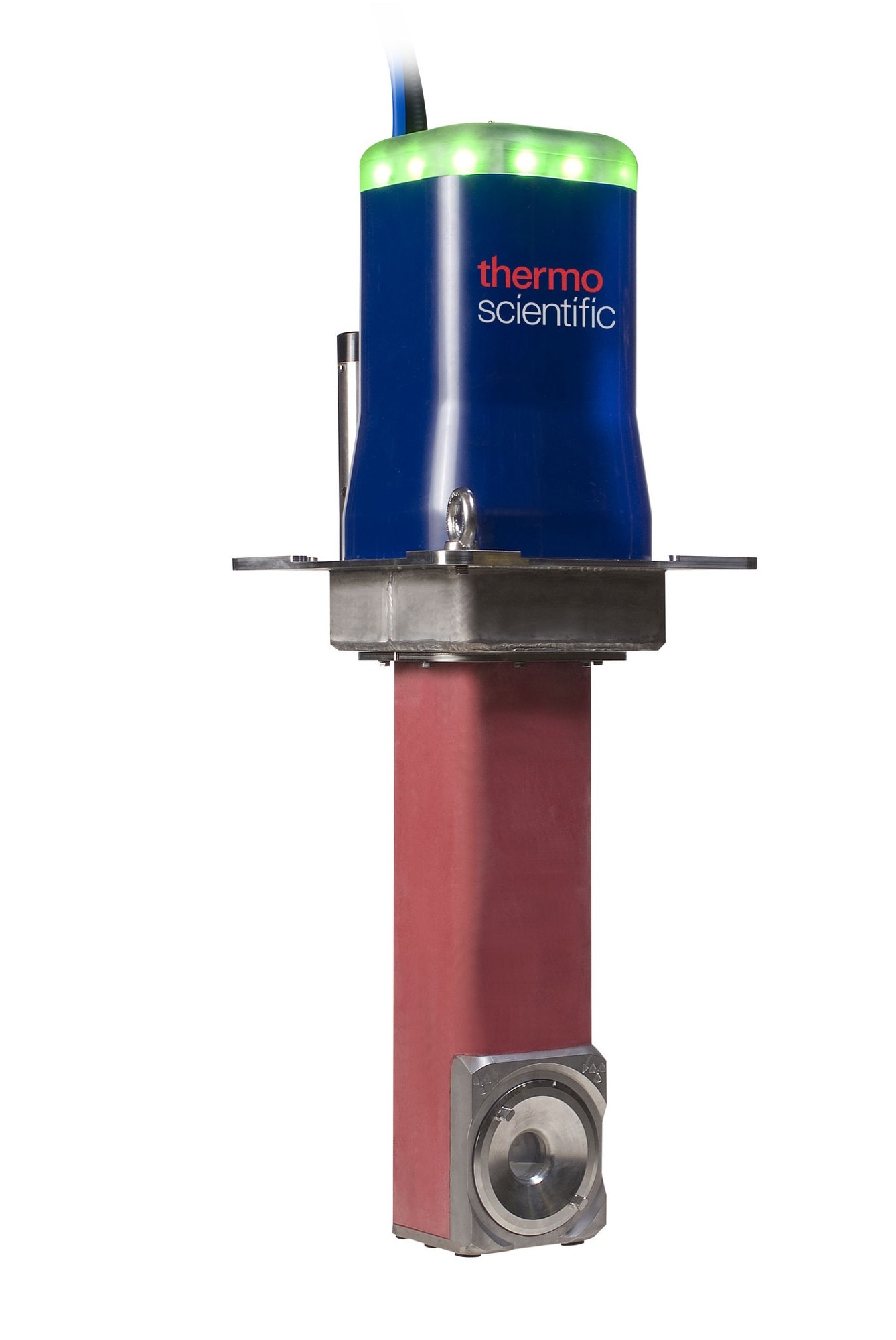
Image Credit: Thermo Fisher Scientific
How has immersion probe XRF technology evolved over time?
This technology has evolved significantly over several generations. The MEP technology, which stands for multi-element probe, was developed to provide elemental analysis directly in slurry applications.
Earlier generations used isotope-based excitation sources. These systems provided valuable process information, but they also came with certain operational requirements, including isotope licensing, permitting, source decay management, and eventual disposal.
The MEP-300 represented an important step forward because it removed the need for liquid nitrogen; the MEP-400 builds on that development by removing the need for isotopes. Instead, it uses a low-power, air-cooled X-ray tube as the excitation source.
That change means the system can provide isotope-free XRF slurry analysis while also incorporating a newer detector, and digital-signal-processing and pulse-processing technologies. These improvements allow the probe to collect more X-ray counts, improve measurement speed, and support more responsive process control.
Click here to watch Analyze That episode 8 - Faster Decisions, Better Data: Advances in XRF for Slurry Analysis
What are the main benefits of using an X-ray tube instead of an isotope source?
One of the main benefits of using an X-ray tube is that it removes many of the operational challenges associated with isotopes. Users no longer need to manage isotope disposal, source decay, or the same level of special permitting and licensing.
An X-ray tube also offers greater flexibility because the X-ray emission can be adjusted by changing the tube power. In the MEP-400, that power is optimized to provide a very high count rate while still supporting good X-ray tube life.
This is a major advantage for process control because higher count rates mean shorter measurement times. In some low-grade, low-solids slurry streams, an isotope-based system might have needed three, four, or even five minutes of counting time. With the newer X-ray tube-based system, that time can often be reduced by at least a factor of four without affecting accuracy.
That makes it possible to discuss minute-by-minute assays in many base-metal mineral recovery systems, including low-grade copper and copper-molybdenum applications.
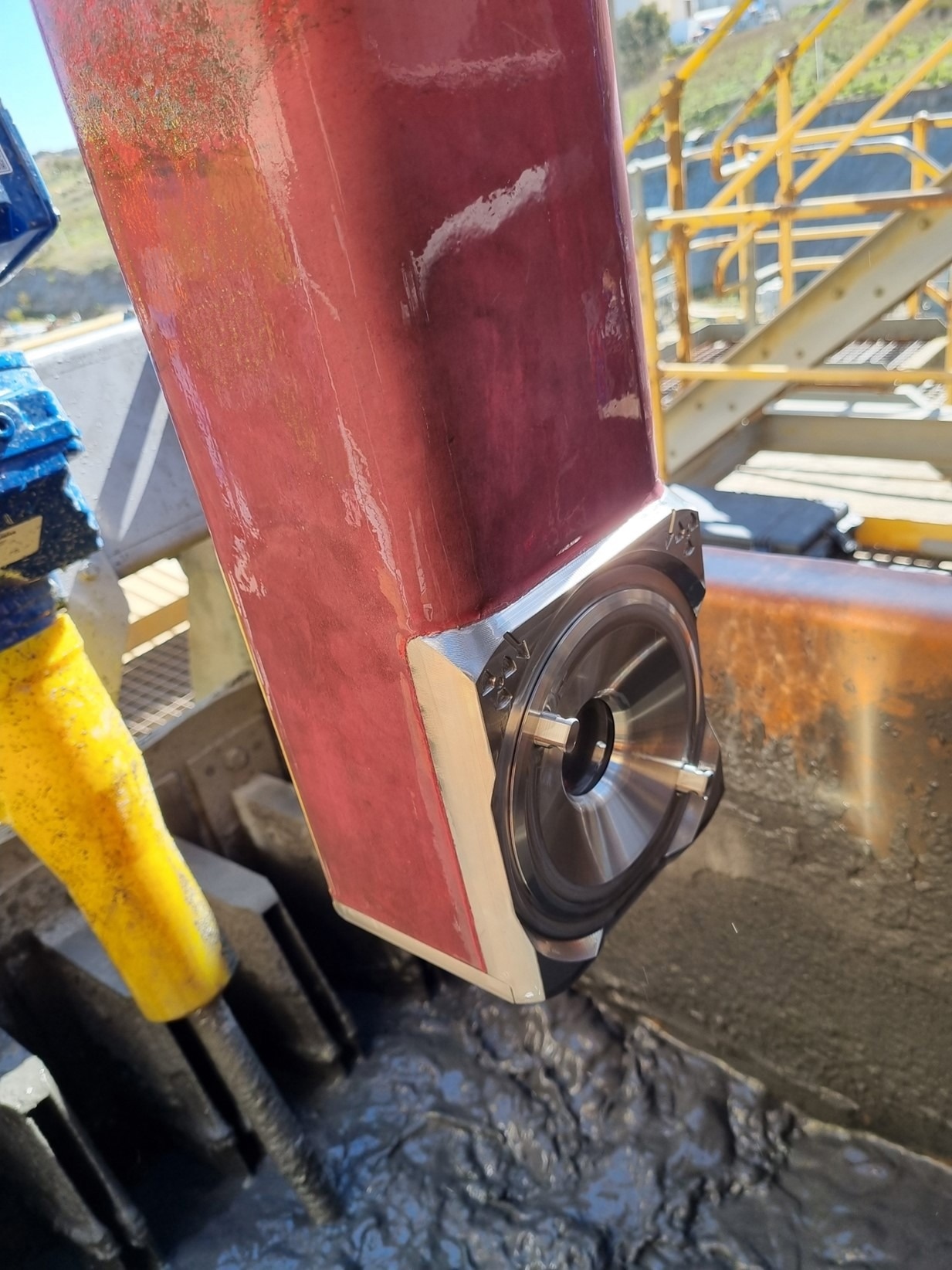
Image Credit: Thermo Fisher Scientific
Why does measurement speed matter so much in modern flotation circuits?
Measurement speed increasingly matters as flotation circuits become faster and more responsive. Traditional large-tank cells often had long residence times, sometimes up to 40 minutes. These systems also provided a lot of mixing, which helped smooth out variability in the feed.
In that type of process, a slower analyzer cycle time was often acceptable because the system itself had a longer response time. Multi-stream analyzer systems could service those circuits effectively because they operated with longer residence times.
Newer pneumatic flotation technologies, such as the Jameson cell and Jameson concentrator, operate differently, with residence times of only a few minutes. That means operators need faster updates to respond to changes properly and take advantage of the controllability of these technologies.
With shorter residence times, there is less mixing to mask variability in the feed. Faster analysis helps operators see what is coming through the cell and make process decisions more quickly.
How does simultaneous multi-element analysis work in this type of system?
The system uses energy-dispersive XRF detection. It includes a large-surface-area Silicon Drift Detector (SDD) with many detector elements. Each detector element can capture and process an X-ray event.
When an X-ray photon reaches the detector, its energy is converted into an electron charge and then into a voltage pulse. The amplitude of that pulse is proportional to the energy of the X-ray.
By counting these events and measuring the pulse amplitudes, the system builds a spectrum. The X axis represents X-ray energy, and the vertical axis represents the number of events detected at each energy. Different elements emit X-rays at different characteristic energies, so the spectrum shows which elements are present.
This allows the system to measure multiple elements simultaneously. In slurry applications, elements from calcium (Ca) to uranium (U) can generally be detected, provided they are present above the detection limit.
What kind of elements can be measured in slurry, and where are the limits?
In slurry applications, XRF can generally measure elements from calcium upward, depending on the concentration and the system's detection limits. This can include elements such as copper (Cu), molybdenum (Mo), iron (Fe), zinc (Zn), lead (Pb), arsenic (As), barium (Ba), and bismuth (Bi).
Improved detector and signal processing in newer systems make it easier to see minor element peaks more clearly. These minor elements can be useful because they may indicate ore type, changes in mineralogy, or factors that could influence reagent consumption, grinding, or flotation performance.
However, there are still limitations. Elements below calcium, such as sulfur (S), silica (Si), and magnesium (Mg), are not generally addressable by XRF in a slurry because self-absorption is too high to get a useful signal out of the slurry.
For those lighter elements, a different real-time analytical technique is needed. For example, PGNAA slurry analysis can be used when users need to measure elements that are not suitable for direct XRF slurry measurement.
Why are minor elements useful in mineral processing analysis?
Minor elements can provide valuable information beyond the main elements of interest. In a copper-molybdenum operation, for example, the main focus may be on the two main elements, but minor elements can still reveal important changes in the ore or process.
Elements such as bismuth, barium, arsenic, lead, zinc, and iron can help indicate ore type, mineralogy changes, or potential process challenges. Some of these elements may also be associated with reagent consumption or flotation behavior.
One advantage of energy-dispersive EDXRF is that the full spectrum is available. If a user is troubleshooting a plant issue and sees a peak in the live spectrum, they can identify the element, configure the analyzer to measure that peak intensity, and build a calibration for it.
They do not need to buy a separate channel to add that element. The capability is already built into the instrument, giving users more flexibility when dealing with complex ores or changing process conditions.
Click here to watch Analyze That episode 8 - Faster Decisions, Better Data: Advances in XRF for Slurry Analysis
How does faster multi-stream analysis support process control?
In a multi-stream analyzer, one analyzer may measure several process streams. If the analyzer is measuring six, eight, or 10 streams, the measurement time on each stream determines the total cycle time.
With longer counting times, the cycle time can become too long to support rapid process control decisions. This is especially challenging in circuits with shorter residence times or higher feed variability.
By reducing the counting time, the analyzer can move through all streams more quickly. In many cases, upgrading to newer probe technology allows users to measure for about one minute per stream. That means the plant receives more frequent updates from each stream, making it easier to respond to changes.
This is particularly useful in modern flotation circuits, where faster feedback can help operators make better decisions about reagent addition, separation performance, and overall circuit stability.
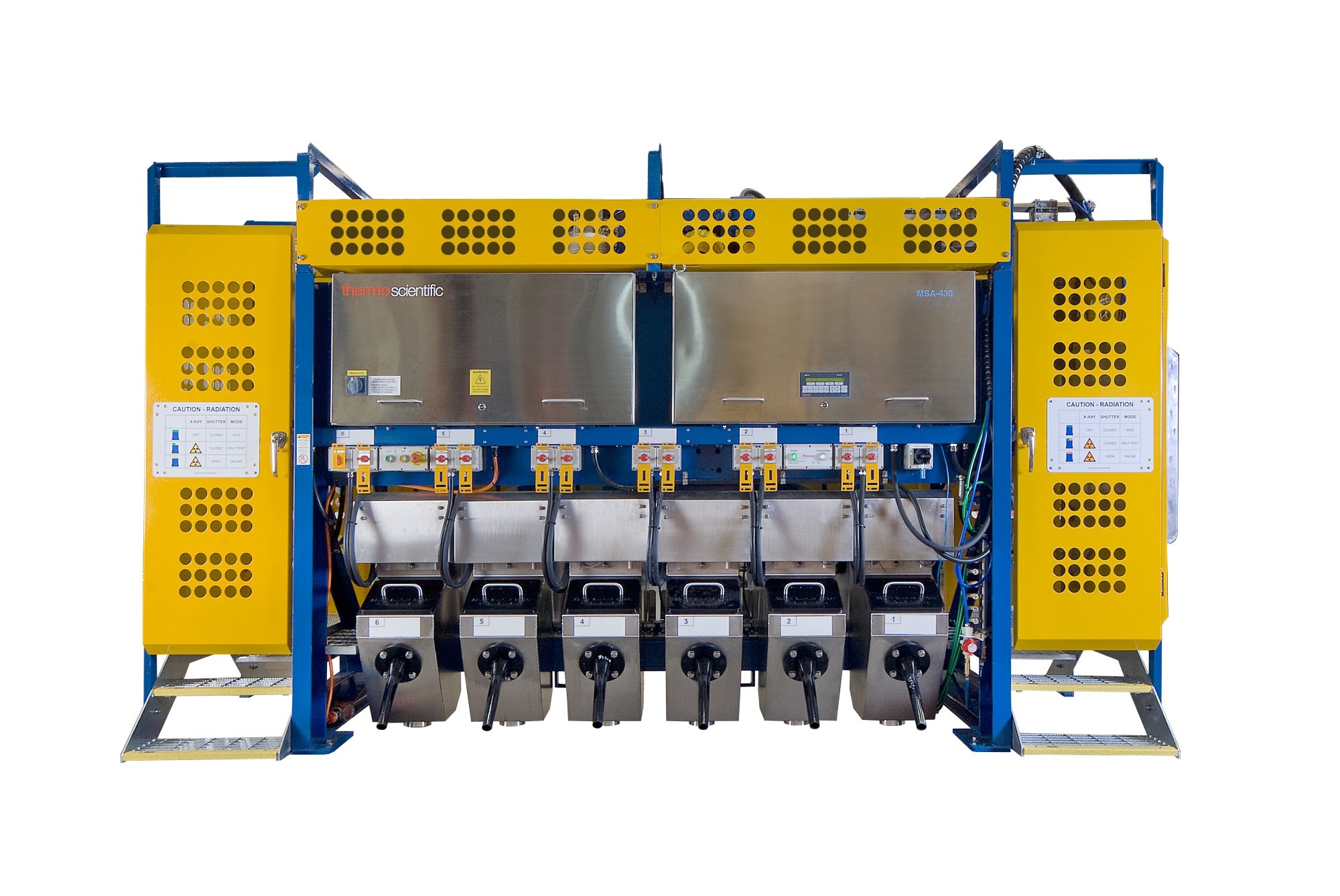
Image Credit: Thermo Fisher Scientific
What safety and maintenance considerations are important for this type of analyzer?
Safety and maintenance are important because these analyzers operate in demanding process environments. Moving away from isotope-based systems reduces the burden on users because they no longer have to manage isotope-related licensing, permitting, disposal, or source decay.
The MEP-400 also includes built-in safety features. It has a built-in shutter, safety interlocks, and an LED semaphore system. If the probe needs to be removed from the slurry stream for cleaning or maintenance, users can press a button and safely extract it using the hoist.
Once extracted, the window can be cleaned, wiped down, acid-washed, or replaced without radiation exposure. In many cases, changing or cleaning the window takes less than five minutes.
Another practical advantage is that key internal components can be replaced in the field. If the detector, X-ray tube, or internal electronics need replacement, spare modules can be kept on-site and installed with appropriate training from service engineers, who can also carry out the replacement if needed.
What does this development mean for the future of slurry process analysis?
The development of isotope-free immersion-probe XRF technology is important because it enables faster, safer, and easier-to-manage real-time slurry analysis. It reduces the operational burden associated with isotopes while improving measurement speed and maintaining strong analytical performance.
For mineral processing operations, this means more frequent process updates, shorter cycle times, and better visibility into elemental changes across the circuit. It also provides more flexibility because users can monitor multiple elements simultaneously and investigate minor elements when troubleshooting or optimizing the process.
This is becoming increasingly important as flotation technologies evolve. Newer separation systems can respond quickly, but they also require faster and more frequent analytical data to be used effectively.
Overall, the technology supports a more responsive approach to process control. It helps operators better understand changing slurry conditions, improve decision-making, and adapt to the faster dynamics of modern mineral processing circuits.
Analyze That episode 8 - Faster Decisions, Better Data: Advances in XRF for Slurry Analysis
Faster Decisions, Better Data: Advances in XRF for Slurry Analysis
About Tom Strombotne
Tom Strombotne holds a BSEE in Electrical and Electronics Engineering from the University of Colorado Boulder. At Thermo Fisher Scientific, he serves as Senior Product Applications Specialist (Minerals), supporting product applications for online elemental and particle size analyzers used in mineral processing.

This information has been sourced, reviewed, and adapted from materials provided by Thermo Fisher Scientific.
For more information on this source, please visit Thermo Fisher Scientific – Analytical Instruments & Solutions.
Disclaimer: The views expressed here are those of the interviewee and do not necessarily represent the views of AZoM.com Limited (T/A) AZoNetwork, the owner and operator of this website. This disclaimer forms part of the Terms and Conditions of use of this website.