In this interview, industry expert Jon Rutter discusses how real-time ore analysis and PGNAA can improve grade control, ore sorting, process decisions, and mine-to-mill performance.
What are some of the biggest challenges facing modern mining operations?
One of the biggest challenges is balancing declining ore grades with the need to maintain economic production.
The Warintza project in Ecuador is a good example. It will produce around 300,000 tons of copper equivalent per year during its first five years, but its proven reserves are relatively low grade at around 0.49% copper equivalent. When you look at the proven and probable reserves, that grade drops further to around 0.41%.
Ten years ago, people were already saying that 0.5% copper would be the grade of the future, and we are now effectively there. That means operations increasingly need to rely on very high throughput, while still managing dilution, ore loss, and large volumes of lower-grade material.
Ultimately, it becomes a question of processing more of the material that generates value and less of the material that does not.
Why is separating ore from waste as early as possible so important?
The earlier you can separate ore from waste in the mining chain, the better.
The first stage is conventional grade control, where material is categorized as ore, low-grade material, or waste. That works, but the selective mining unit, or SMU, can still be very large, commonly tens of kilotons.
With large shovel buckets and haul trucks, there are practical limits to how selectively material can be mined at the dig face. That means some waste inevitably travels further into the process than we would ideally like.
If you can introduce another opportunity to distinguish ore from waste further downstream, you can reduce the size of the material packages you are making decisions on from tens of thousands of tons to tens of tons. That gives you much greater selectivity before material reaches grinding and flotation.
How can real-time ore analysis improve that level of selectivity?
Technologies such as cross-belt PGNAA provide what I would describe as a second opportunity for grade control.
Once the material reaches the conveyor belt, systems such as the Thermo ScientificTM CB OmniTM Agile Online Elemental Cross-Belt Analyzer can analyze much smaller parcels of material. Instead of treating an entire dig block as one unit, you can start making decisions on packages that may only represent tens of tons.
That allows you to identify and remove waste before it reaches grinding and flotation, or redirect valuable material that might otherwise have been lost.
The real advantage is greater granularity. You are no longer relying entirely on broad averages from large mining blocks. You can measure the material in front of you and make a more confident decision about whether it should continue into the process plant.
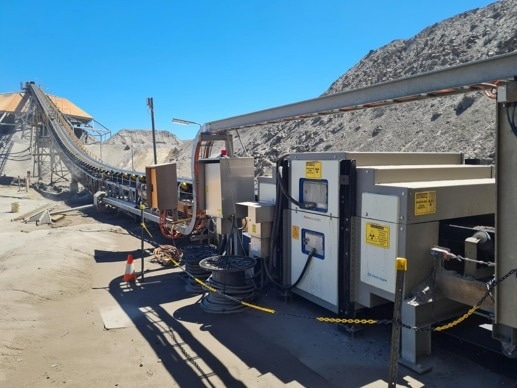
Thermo Scientific CB Omni Agile Online Elemental Analyzer. Image Credit: Thermo Fisher Scientific – Minerals Processing and Analytical Solutions
Click here to watch Analyze That episode 19 - From Mine Face to Mill: Turning Ore Variability into Recovery with Real-Time Analysis
What information can PGNAA provide beyond simply measuring metal grade?
One of the strengths of PGNAA is that it can measure around half or more of the periodic table, including many light elements.
In a copper operation, for example, you can measure sulfur, aluminum, silica, calcium, and magnesium alongside the targeted metals. That means you can do more than simply quantify copper. You can start to understand whether that copper is associated with minerals such as chalcopyrite, bornite, or other sulfide minerals.
That information can give the metallurgical team a much clearer understanding of what is actually entering the process plant. They can then adjust the process according to the real mineralogy rather than relying on an expected average.
You can also calculate aspects of the gangue mineralogy, which can provide information about hardness and help operators anticipate impacts on throughput and grinding in the SAG mill and ball mills.
Why can gangue composition sometimes be as important as the target metal?
Mining is fundamentally an economic activity, so the important question is how much metal is present and whether it can be recovered economically.
Copper or nickel may be the elements that ultimately generate revenue, but other elements can have a major impact on processing costs. If calcium and magnesium are too high in material going to leach pads or an autoclave, for example, you may end up consuming sulfuric acid dissolving gangue rather than recovering the copper.
At that point, the material may technically contain metal, but it may no longer qualify as ore economically.
That is why measuring gangue can sometimes be more important than measuring the metal itself. Understanding the full composition of the feed allows you to assess whether processing that material will actually generate value.
Where does PGNAA complement established techniques such as XRF?
XRF is an excellent analytical technique, and if it is already delivering what you need, there is no reason to replace it. The issue is that XRF has physical limits on what it can measure.
For example, XRF cannot measure elements below calcium effectively in these online applications. That becomes important when you need information about lighter elements such as sulfur.
Consider a refractory gold operation. Gold may ultimately pay the bills, but you cannot directly measure a few grams per ton of gold online in the feed using XRF. If the process involves floating a pyrite or sulfide concentrate for ultrafine grinding or an autoclave, however, sulfur becomes a very useful proxy.
A PGNAA slurry analyzer such as the Thermo ScientificTM GS Omni Light Element Analyzer can measure sulfur in real time in the feed, concentrate, and tails. That lets operators respond immediately if sulfides are being lost to tailings, rather than waiting until a laboratory composite assay arrives the following day, when that gold has already been lost.
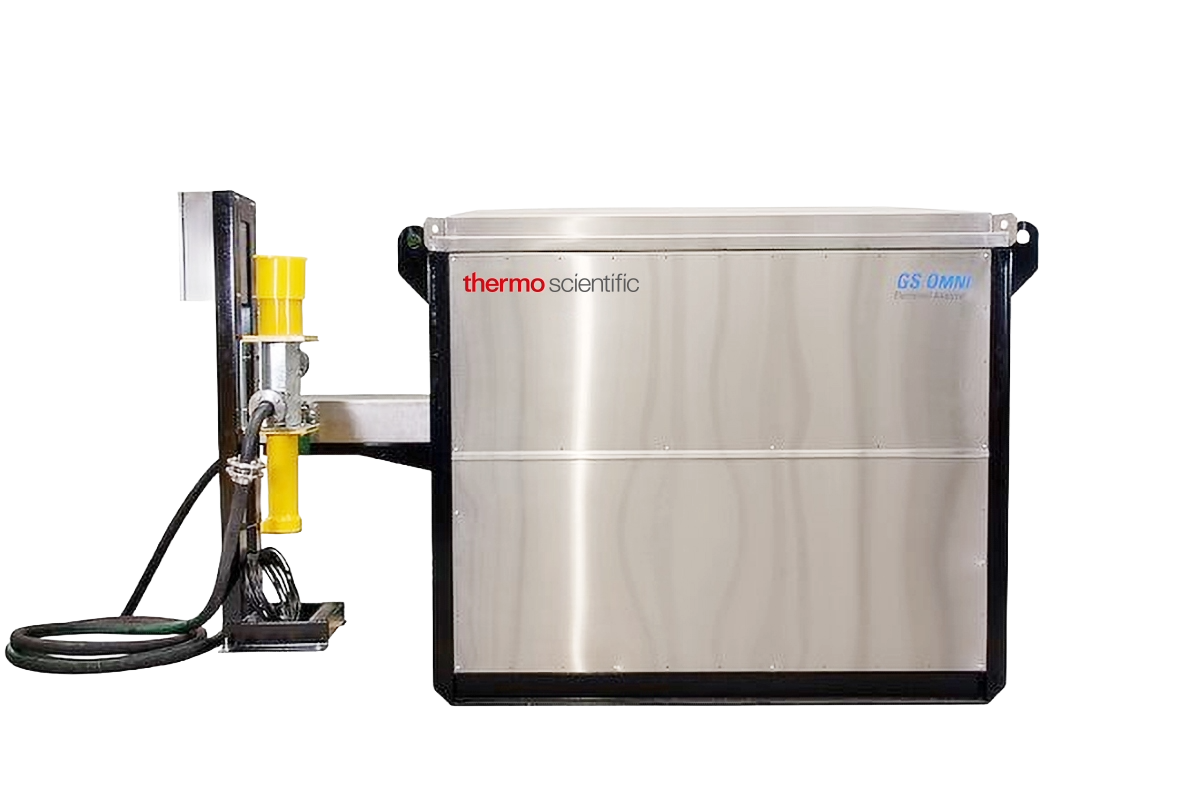
Thermo Scientific GS Omni Light Elemental Analyzer. Image Credit: Thermo Fisher Scientific – Minerals Processing and Analytical Solutions
How can real-time analysis improve processing beyond copper and gold operations?
The same principles apply across many different commodities because once you have reliable data, you can convert it into information that supports an actionable process decision.
In phosphate production, for example, a cross-belt PGNAA analyzer can measure phosphorus alongside calcium, magnesium, silica, and aluminum before reverse flotation. Those same light elements can also be monitored within the flotation plant using a PGNAA slurry analyzer.
That information can improve grade control before grinding, support flotation performance, and help optimize downstream chemical processing. After flotation, knowing the phosphorus and calcium content can also improve reagent dosage control and reduce sulfuric acid consumption.
The same concept applies in iron ore operations targeting green steel, where controlling silica and aluminum can be just as critical as measuring the iron itself.
Click here to watch Analyze That episode 19 - From Mine Face to Mill: Turning Ore Variability into Recovery with Real-Time Analysis
How does better ore characterization influence processing decisions?
Better characterization gives sites more confidence when choosing where material should go.
An ore parcel might be directed to the leach pads, the sulfide mill, or a low-grade stockpile depending on its composition and economics. The key decision is which processing route gives the lowest cost per ton per unit of metal produced.
Technology does not make that business decision for you. It provides the information needed to make the decision properly.
Greater granularity also improves selectivity. At an oxide-sulfide transition, for example, some secondary sulfide minerals may be partially leachable and could be economically sent to a leach route. Chalcopyrite-dominated material, on the other hand, may not respond effectively to leaching and would need to be directed toward flotation.
The value comes from knowing what the material actually is before committing it to a processing pathway.
Can real-time analysis also improve upstream mine planning and grade control?
Absolutely. The information doesn't just need to travel forward into the process plant; it can also be fed back into grade control and the mine itself.
Real-time analysis of delivered ore can help identify which stopes or dig blocks are underperforming, whether there is an unrecognized dilution problem, or whether an entire geological domain is consistently behaving differently from what was expected.
Once you have that information with confidence, you can incorporate it back into resource block models, mine planning, scheduling, and forecasting.
Traditional reconciliation often happens after the event. By the time you identify a problem several weeks later, it is too late to change what happened. Real-time PGNAA data potentially allows you to identify an underperforming block while the shovel is still at the dig face, or even shut down an uneconomic stope before additional value is lost.
Looking ahead, what is the wider value of bringing real-time analysis into mining operations?
For me, it comes back to confidence in the decisions you are making.
Throughout my career in grade control and mine-to-mill reconciliation, I've seen many occasions when you look at a block and wish you could separate the waste instead of sending it through the mill, or recover a package of higher-grade ore instead of losing it to the waste dump.
The difference now is that the technology exists to measure material on the conveyor belt, quantify it, and make those decisions with much greater confidence.
For greenfield sites, the ideal time to consider this is during the PFS and FS stages, when you can evaluate different processing pathways as part of the business case. Brownfield sites can also retrofit these capabilities; for example, a CB Omni Agile can be installed on an existing mill conveyor to capture the data needed to build the business case and support real-time decisions.
Ultimately, the value is knowing that ore is ore, waste is waste, and understanding exactly what is entering the mill rather than relying on a broad estimate. That gives the metallurgical team a much better opportunity to maximize recovery, reduce unnecessary processing, and generate greater value from the resource.
Analyze That episode 19 - From Mine Face to Mill: Turning Ore Variability into Recovery with Real-Time Analysis
From Mine Face to Mill: Turning Ore Variability into Recovery with Real-Time Analysis
About Jon Rutter 
Jon Rutter has over 25 years of global experience across the metalliferous mining sector, spanning exploration through to large-scale open pit and underground caving operations. His expertise includes mine geology, grade control, resource development, mine planning, process plants, and mine-to-mill optimisation.
He has held senior operational and leadership roles, delivering business improvement and process optimisation initiatives, and has extensive experience in pre-concentration strategies, including bulk ore sorting implementation.
At Thermo Fisher Scientific, Jon leverages his operational background to deliver practical, data-driven solutions that improve mining and processing performance while supporting more efficient and sustainable operations.

This information has been sourced, reviewed and adapted from materials provided by Thermo Fisher Scientific – Minerals Processing and Analytical Solutions.
For more information on this source, please visit Thermo Fisher Scientific – Minerals Processing and Analytical Solutions.
Disclaimer: The views expressed here are those of the interviewee and do not necessarily represent the views of AZoM.com Limited (T/A) AZoNetwork, the owner and operator of this website. This disclaimer forms part of the Terms and Conditions of use of this website.