Why Rock Blocks Every Signal
Wired Networks and Their Hidden Fragility
Wireless Options Underground
Sensor Networks and Data Transmission
Why this Infrastructure Stays Invisible
References and Further Reading
Deep mines struggle to keep people connected because rock, depth, and dust block conventional signals. This forces engineers to create overlapping networks that often fail quietly and frequently.
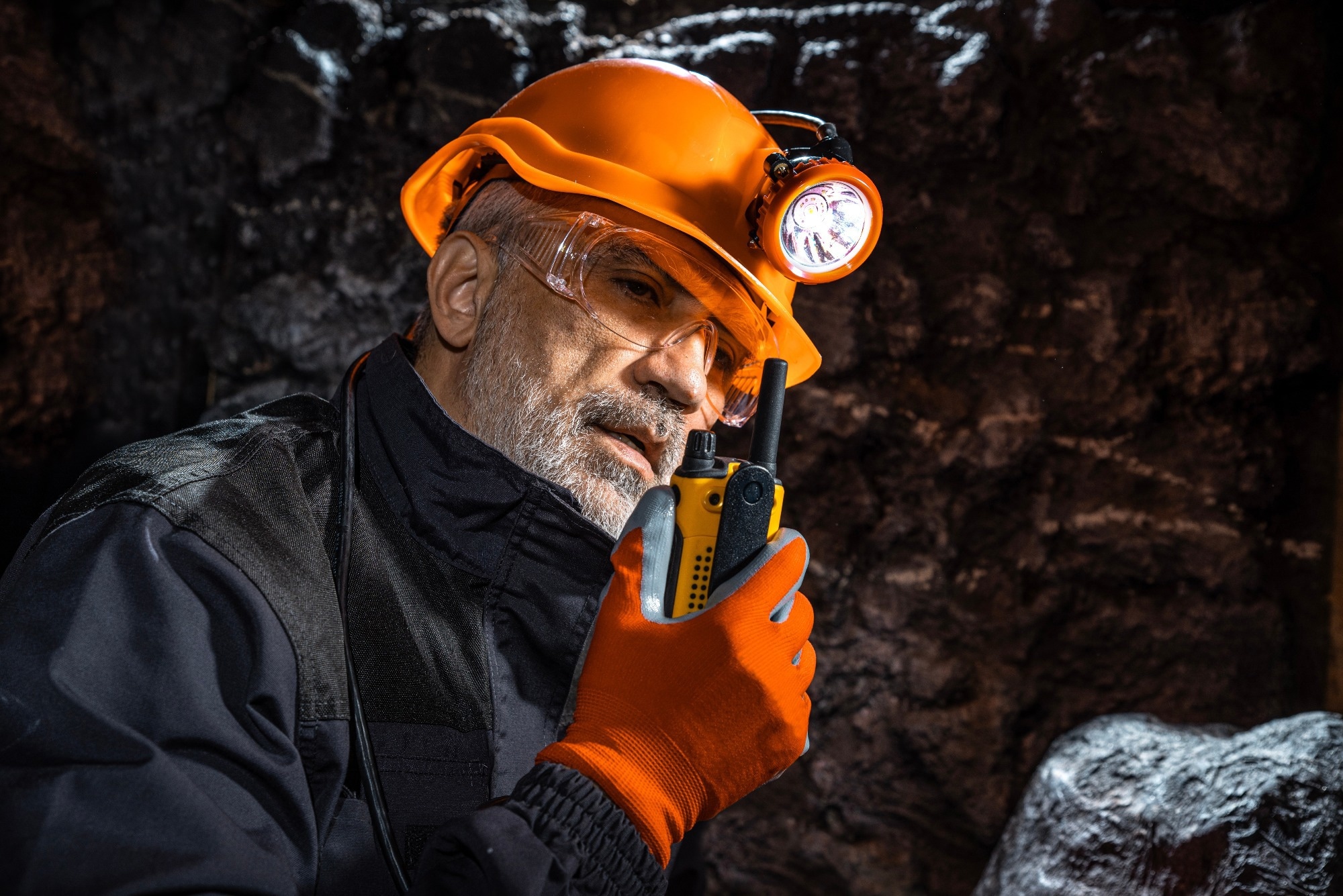
Image Credit: TSViPhoto/Shutterstock.com
Communication in deep mines functions like the operation’s nervous system, carrying safety alerts, production data, and voice traffic through an environment that is inherently difficult for signals to traverse. The problem rarely announces itself until the moment a network stops responding during a crisis, when every second of silence carries weight for everyone waiting on the surface.
Why Rock Blocks Every Signal
Radio waves quickly lose strength underground because rock absorbs and scatters energy in ways open air never does. Frequency choice matters enormously here, since lower frequencies travel farther through stone but carry less data, while higher frequencies carry more information yet often die within meters of a wall.1
Mine tunnels bend, narrow, and branch constantly, so a signal that reaches one heading may vanish entirely around the next corner. Metal-rich ore bodies, water seepage, and coal seams each interact differently with radio energy, meaning a system tuned for one mine section often performs poorly in another once conditions shift underground.2
Dust and humidity introduce additional interference, especially in coal operations where methane monitoring depends on reliable data links reaching the surface without delay. Engineers treat each mine as a distinct radio environment, testing signal behavior at each depth and rock type before selecting equipment for that zone, then adjusting placement as extraction progresses through new seams.3
Temperature shifts between the deep working areas of a mine and the cooler ventilation shafts can affect the way radio waves travel. Similarly, changes in air density influence signal propagation in narrow passages. To address this, surveyors continuously map signal strength in the mine, creating models that predict where dead zones may appear as tunnels extend further from the main shaft over time.2
Wired Networks and Their Hidden Fragility
Leaky feeder cables have been used in underground operations for decades, providing continuous signal coverage along their length to accommodate winding tunnels. This method is effective for voice communication and basic data transfer. However, a single break in the cable caused by a rockfall or a passing vehicle can cut off communication in an entire section. This leaves crews without contact until repairs are completed.4,5
Fiber-optic lines help overcome these limitations by carrying far more bandwidth for video and sensor data, supporting the growing demand for remote operation of equipment from surface control rooms. Fiber remains vulnerable to physical damage too, and repairing a severed line often requires sending workers into the exact hazardous zone the system was meant to protect in the first place.2,3
Redundancy planning is an important design objective in modern mine design, with operators running parallel cable paths or backup wireless links alongside primary wired systems. This layered approach costs more upfront, but a mine that loses its only communication path during an emergency faces consequences far beyond the price of extra cable.4,5
Maintenance crews now schedule regular inspections of cable routes precisely because these hidden failures tend to surface without warning signs, potentially catching operators off guard during peak production hours.4,5
Wireless Options Underground
Wi-Fi and cellular networks are increasingly being placed underground, offering mobility that cables cannot match on foot or in vehicles moving through active headings. Access points placed along tunnels create zones of coverage, though tunnel geometry may necessitate frequent repositioning as mining advances and old headings close permanently.2
Intelligent reflecting surfaces are a newer approach that uses passive panels mounted on tunnel walls to redirect radio energy around obstacles such as machinery and support structures.
Simulation research on their use in coal mines suggests that intelligent reflecting surfaces could improve data transmission rates when placed at strategically calculated points along a tunnel. By adjusting phase shifts, they effectively steer the signal energy toward receivers waiting for the data.6
Through-the-earth radio offers a different advantage, since surface transmitters can reach underground receivers even after tunnels collapse or fires cut every cable running below. Coverage depths remain limited compared with wired systems, and voice transmission stays rare, so most through-the-earth systems handle alerts and brief text messages rather than full conversation between crews on shift.4,5
Sensor Networks and Data Transmission
Modern mines generate large volumes of environmental data, constantly tracking gas concentration, ground stability, and equipment status across every active zone.
LoRa-based systems are being investigated for this purpose, transmitting small data packets across long distances using minimal power, which suits battery-operated sensors placed far from any fixed power source.1
However, in one mine-model study, non-line-of-sight reception was lost at 17 meters, indicating underground deployments may still require regularly spaced relay or booster nodes. 1
Visible light communication has emerged as a promising complement to radio-based systems, using LED fixtures already installed for illumination to carry data alongside light throughout working tunnels. Combined with fiber-optic backhaul, these systems support both personnel tracking and continuous methane monitoring.3
Power delivery to remote sensors remains a persistent obstacle, since running electrical cable to every monitoring point across a sprawling mine adds cost and creates new failure points along the way.
Engineers are continuing to test energy-harvesting methods that draw power from vibrations or temperature differences. However, none have yet replaced batteries on a large scale across multiple levels and decades-old operations.1
Why this Infrastructure Stays Invisible
In mines, communication systems often go unnoticed during regular operations. Workers are more aware of ventilation, lighting, and haulage equipment in the daily underground work. The moment a signal drops during an emergency, that invisible layer becomes the difference between an organized evacuation and confusion spreading through the workforce in seconds.4,5
Regulatory bodies now require redundant communication paths in many jurisdictions, pushing mines toward hybrid designs that combine leaky feeder, fiber, and wireless mesh coverage across a single site.
Building this layered infrastructure demands significant capital investment. However, the alternative is a mine that cannot reach its underground workers, carrying significant risks.
Future mine design is likely to treat communication planning with the same priority as ventilation shafts and escape routes, built into the mine layout from the earliest design stage rather than added afterward, once tunnels already exist.
As automation and remote operation expand across the industry, the pressure to solve this invisible infrastructure problem will only grow stronger with each new project breaking ground around the world today.6
References and Further Reading
- Kumar, P. P., Paul, P. S., & Ananda, M. (2023). Development of LoRa Communication System for Effective Transmission of Data from Underground Coal Mines. Processes, 11(6). https://www.mdpi.com/2227-9717/11/6/1691.
- Ikeda, H. et al. (2024). Development of underground communication system for data transmission using Wi-Fi direct and power line communication. Tunnelling and Underground Space Technology. 153. https://www.sciencedirect.com/science/article/abs/pii/S0886779824004656.
- Stoicuta, O. et al. (2023). Application of Optical Communication for an Enhanced Health and Safety System in Underground Mine. Sensors, 23(2). https://www.mdpi.com/1424-8220/23/2/692.
- Bakshi, S. C. et al. (2025). On Underground Mine Communication Systems. ICDCN '25: Proceedings of the 26th International Conference on Distributed Computing and Networking. https://dl.acm.org/doi/10.1145/3700838.3703680.
- Salam, A. et al. (2020). Signals in the Soil: An Introduction to Wireless Underground Communications. Faculty Publications, Purdue University. Paper 37. https://docs.lib.purdue.edu/cgi/viewcontent.cgi?article=1039&context=cit_articles.
- Liu, Y. et al. (2024). Rate Optimization of Intelligent Reflecting Surface-Assisted Coal Mine Wireless Communication Systems. Entropy, 26(10). https://www.mdpi.com/1099-4300/26/10/880.
Disclaimer: The views expressed here are those of the author expressed in their private capacity and do not necessarily represent the views of AZoM.com Limited T/A AZoNetwork the owner and operator of this website. This disclaimer forms part of the Terms and conditions of use of this website.