In this interview, Jeff Williams, CEO and CTO of Exum Instruments, discusses how Laser Ablation Laser Ionization Time-of-Flight Mass Spectrometry (LALI-TOF-MS) enables rapid, comprehensive elemental analysis of geological samples and how the technology could support more efficient, automated mining workflows.
Could you introduce yourself, your role at Exum Instruments, and what first led you to recognize the potential of mass spectrometry for mining and mineral exploration?
My background is in geochemistry and cosmochemistry, with a focus on meteorites and early solar system formation. That gave me experience with a wide range of analytical instruments and highlighted how difficult comprehensive solid-sample analysis can be.
Traditionally, samples may require acid digestion, extensive chemistry, and weeks of analysis. We wanted to create a system where you could put a rock directly into an instrument, hit it with a laser, and quantitatively measure every element from lithium (Li) to uranium (U). That led to Massbox and our LALI-TOF-MS technology.
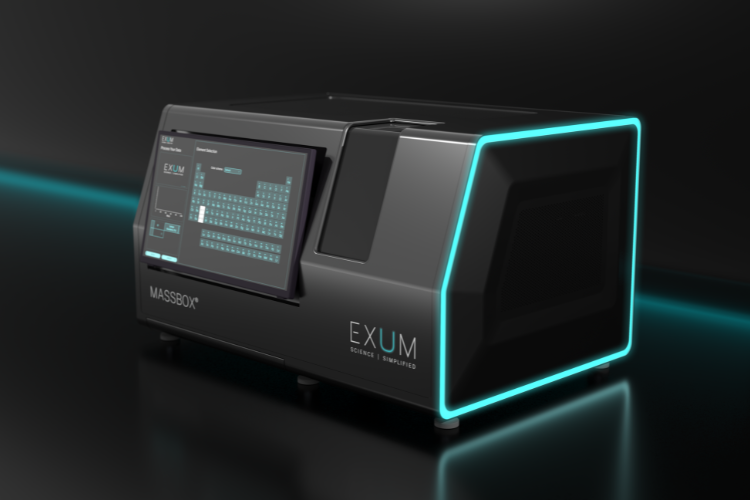
Image above: Massbox®
Image Credit: Exum Instruments
When using LALI-TOF-MS, what can geologists learn from a single rock sample that can be challenging to obtain through conventional techniques?
Traditional workflows often require several techniques to answer different questions, such as fire assay for gold, ICP-MS for trace elements, and XRD for mineralogy.
With Massbox, we can analyze cores, cuttings, powders, or fused discs and measure every element from lithium to uranium, with detection limits down into the hundreds of parts per billion. Because we collect a full mass spectrum at every laser spot, we can also create chemical maps showing both how much of an element is present and where it is located, while supporting indirect mineralogy.
How does the dual-laser LALI approach change the analytical workflow compared with conventional solid-sample analysis?
LALI uses one laser to ablate the sample and another to ionize it before analysis with a time-of-flight mass spectrometer. This allows us to directly analyze solids without extensive acid digestion or dilution.
Analysis takes place in high vacuum, reducing interferences such as oxides and argides. Our software then identifies elements, applies calibration curves, and generates quantitative results and elemental maps. Instead of moving between multiple instruments, users can obtain a comprehensive dataset from Massbox and combine it with complementary techniques such as SEM when needed.
How can capturing a full mass spectrum at every measurement point shorten the time from sample collection to decision-making?
During exploration, Massbox can operate in a mobile laboratory environment and analyze drill cuttings or core on-site. This means teams can determine whether they're vectoring toward a deposit without waiting weeks for external laboratory results.
The same capability can support grade control, process control, and concentrate analysis by identifying valuable elements alongside unwanted penalty elements such as arsenic. Having this information available much closer to the process enables faster decisions throughout the mining value chain.
Why are light elements such as lithium (Li) and beryllium (Be), as well as trace critical minerals and rare-earth elements, particularly challenging to measure?
X-ray techniques have difficulty with very light elements with sodium (Na) and below effectively representing a blind spot. This makes direct lithium and beryllium analysis challenging for techniques such as XRF and SEM-EDS, sometimes forcing companies to identify lithium indirectly using other tracers.
Rare-earth elements can be measured using X-ray techniques, but sensitivity can also be limiting. LALI-TOF-MS provides PPM and, in some cases, PPB-level sensitivity while identifying lanthanides and other elements within every laser shot.
How can Massbox's elemental maps improve resource modeling, geometallurgical planning, and processing strategies?
Elemental maps can show where target elements occur, which minerals host them, and what other materials are associated with them. This can help determine appropriate processing strategies and identify potential challenges earlier.
Because we're not only looking for predefined elements, we can also identify unexpected value. A copper (Cu) deposit, for example, might contain economically interesting gallium (Ga), germanium (Ge), or tungsten (W), while also containing penalty elements such as arsenic (As). The full dataset can therefore provide a more complete picture of a deposit's potential economic value.
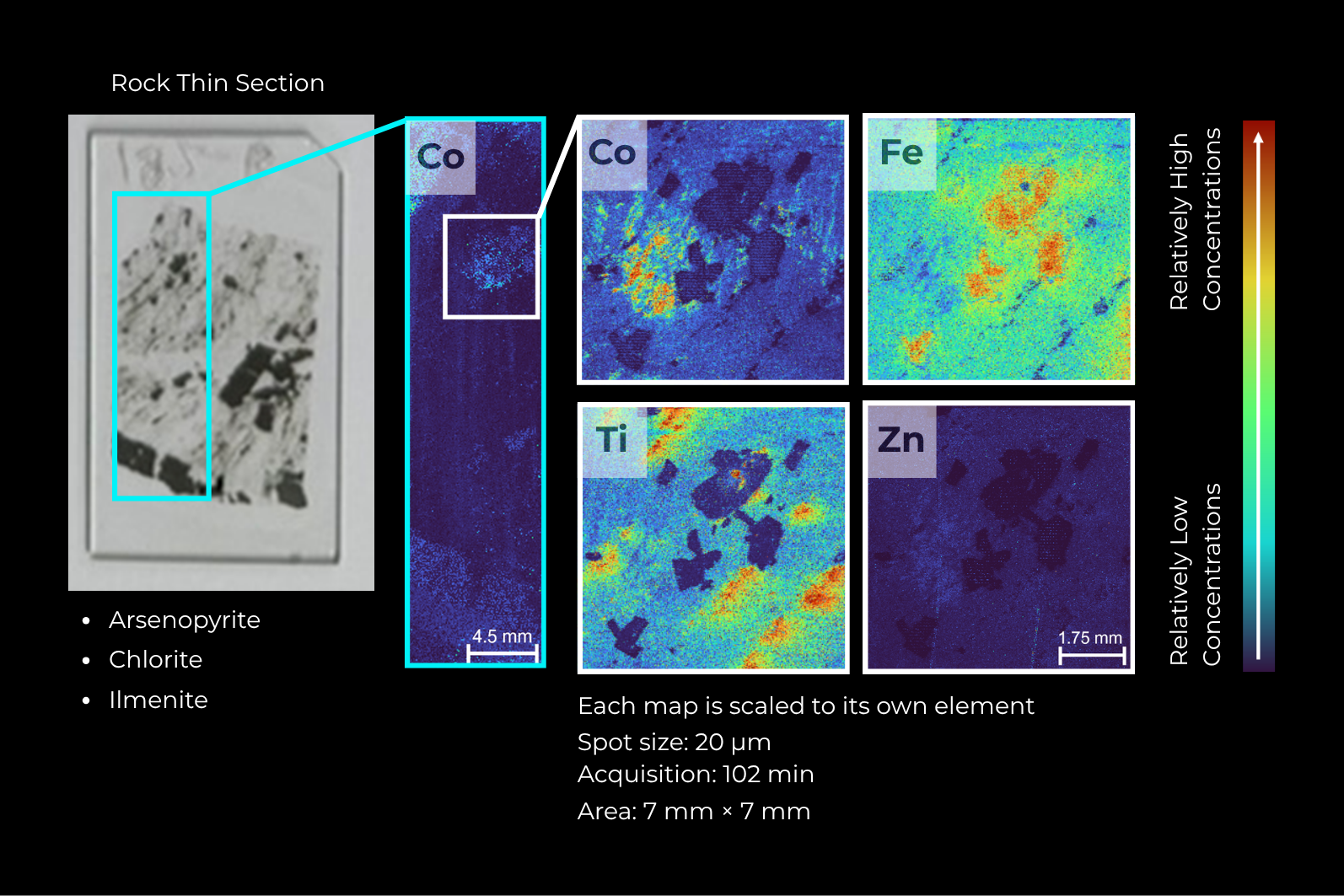
Image above: Massbox mapped a rock thin section containing arsenopyrite, chlorite, and ilmenite, first scanning a 9 mm × 35 mm area at 80-micron resolution to pinpoint a cobalt-rich zone. Then a follow-up 7 mm × 7 mm map at 20-micron resolution revealed not only the target Co signal but also correlating Fe and Ti, plus trace-level Zn in the ppm range - all captured from a single sample in one analytical session.
Image Credit: Exum Instruments
How has Massbox been designed to overcome the challenges of operating mass spectrometry directly at a mine site?
Massbox requires a solid sample with a relatively flat surface, which fits well with existing workflows for cores, cuttings, and pressed powders. It doesn't require noble gases, acids, or consumables and operates from a single power connection, allowing it to be deployed in trailers, shipping containers, and vans.
We've also focused heavily on usability. The software guides operators through sample loading and analysis, automatically identifies elements, applies calibration curves, and generates maps. The next-generation Massbox was specifically designed around uptime, reliability, robustness, and ease of use in industrial environments.
Looking ahead five to 10 years, how do you see LALI-TOF-MS fitting into the mining industry's analytical toolkit?
Initially, we see LALI-TOF-MS bringing elemental analysis on-site and reducing laboratory turnaround times from weeks to minutes. It also complements techniques such as large-format SEM, where mineralogical information can be combined with Massbox's quantitative, low-detection-limit elemental analysis.
In the longer term, we expect greater integration into automated "lights-out" laboratories, combining technologies such as SEM, Massbox, and hyperspectral imaging. Machine learning and AI could increasingly interpret these integrated datasets and automate decisions, while instruments are operated without requiring an analytical chemist onsite. Ultimately, mining is moving toward understanding the full value of a deposit rather than targeting a single element, and richer, more integrated analytical workflows will be central to that shift.

About Jeff Williams, CEO / CTO
As Exum Instruments’ Founder and CEO / CTO, Jeff Williams drives both strategy and technical development. After years of experience in research laboratories using a suite of analytical techniques, he recognized the analytical instrument industry was ripe for disruption. Jeff founded Exum with a mission to rethink how we measure the world around us, and by doing so, accelerate the growth of key verticals in the next era of technology. As part of this mission, Jeff led the Exum Team to develop Massbox from idea to prototype to commercial instrument.
This information has been sourced, reviewed, and adapted from materials provided by Exum Instruments.
For more information on this source, please visit Exum Instruments.
Disclaimer: The views expressed here are those of the interviewee and do not necessarily represent the views of AZoM.com Limited (T/A) AZoNetwork, the owner and operator of this website. This disclaimer forms part of the Terms and Conditions of use of this website.