Where Antimony Goes
A Fragile Supply Chain
Export Controls and Price Shocks
The Environmental Threat
Chemistry, Crops, and Health
Balancing Supply and Safety
References and Further Reading
Antimony (Sb) is a brittle, silver-gray metalloid that was once used in cosmetics and early medicines. Today, it is found in fire-resistant plastics, car batteries, solar panels, and military equipment, leading governments to classify it as a critical resource.
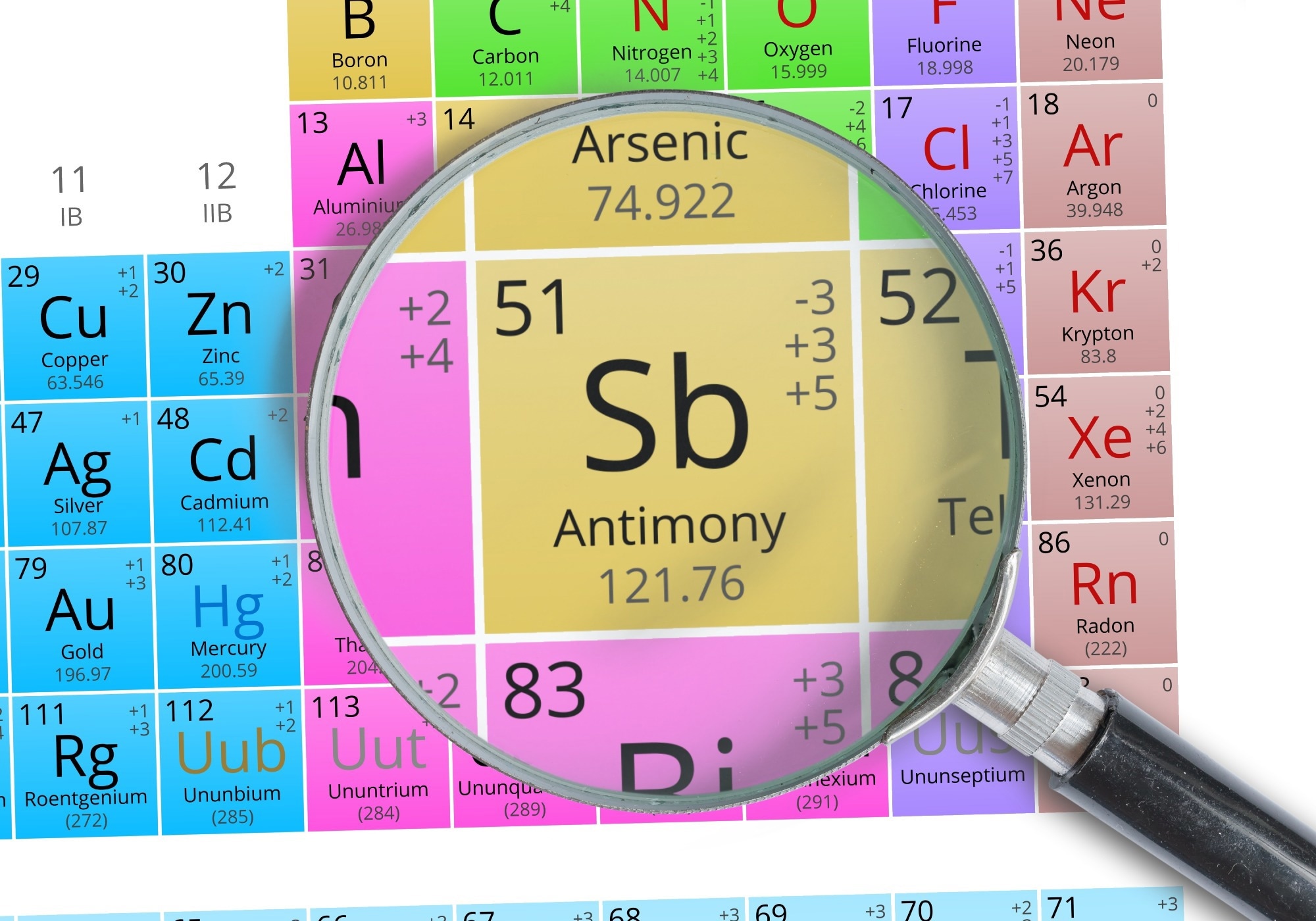
Image Credit: vchal/Shutterstock.com
However, antimony can accumulate in soils and crops near mining sites, posing an environmental threat. This dual nature of antimony connects the importance of supply security with the need for pollution control.
Where Antimony Goes
Antimony trioxide helps slow the spread of fires in plastics, textiles, and electronics. Due to this capability, flame retardants account for the largest share of global antimony demand. Antimonial lead is also used in lead-acid batteries; many smelters recover this metal from used batteries, and the battery industry recycles it, creating a reliable internal supply loop.1
Solar energy is another fast-growing market for antimony. Around 20% of antimony use is for photovoltaic glass, where antimony trioxide acts as a clarifying agent that boosts cell performance. Chinese solar manufacturing has expanded so quickly that more antimony ingots now stay inside China for domestic consumption. This transition to renewable energy puts more pressure on a market that was already tight before trade disputes started.2
Defense applications give the element strategic weight. It is used to strengthen lead bullets and in armor-piercing ammunition, night-vision goggles, infrared sensors, and precision optics. Similarly, antimony trisulfide is used in missile and munitions production.
A Fragile Supply Chain
Antimony mining is concentrated in a very small number of countries. The U.S. Geological Survey estimates world mine output at 110,000 metric tons. China and Russia are the leading producers, generating around 40,000 and 32,000 metric tons, respectively, while Tajikistan contributes about 22,000 metric tons.
Together, these three countries provide about 85% of the global total. This leaves manufacturers in other countries with limited options if one producer changes its policies.1
In the mid-twentieth century, American mines supplied over 90% of the country's antimony needs. However, this self-sufficiency declined when environmental regulations tightened in the 1970s, leading to major closures across the country over the following decades.3
Processing is even more concentrated. Since 2022, China has produced over 70% of the world’s antimony trioxide. It also imports ore from Thailand, Myanmar, and Russia to keep its refineries running. Despite this stronghold over processing, China's ore output dropped from 61,000 tons in 2020 to 40,000 tons in 2023 due to lower ore quality and tougher environmental laws. Pollution policies explicitly affect supply.2
Although refining capacity outside China exceeds 60,000 tons per year, much of it goes unused because mines can't supply sufficient concentrate.
New refineries won't solve such shortages on their own. Investors are now looking at deposits once thought too small, remote, or complicated, including inactive mines in North Macedonia, Slovakia, and Central Asia. Reopening these sites could bring economic benefits, but also new environmental obligations.4
Export Controls and Price Shocks
On August 14, 2024, China announced licensing requirements for six antimony products, including ore, metal, and oxide, as well as gold-antimony smelting technologies.
These new measures closely followed earlier controls on gallium (Ga), germanium (Ge), and graphite, confirming that critical minerals had become deliberate tools of national trade policy. American defense planners responded with alarm, since domestic mining remained several years away and no large alternative source existed anywhere.3
Beijing then banned all antimony exports to the United States in December 2024. The average monthly price rose from $9.80/pound in August to $18.10/pound in December, then reached $27.50/pound by June 2025. U.S. net import reliance climbed to 91%, and recycling covered only 12% of domestic consumption.
As a result, mining restarted in Montana, and construction began on an Idaho project that same year.1
The Environmental Threat
Mining is the largest human source of antimony entering soil, with global releases estimated at 4.7 to 47 million kg/year.
Smelter dust, open tailings ponds, and wastewater carry the element into nearby land and streams; wind spreads it even farther. A study of a peat core from Flanders Moss in Scotland recorded a 50–100-fold rise in airborne antimony during the twentieth century.5
A recent review in Environmental Research and Public Health examined 552 soil samples from mining and smelting sites across 21 countries. It found that 72% of these samples exceeded the 36 mg/kg limit set by the World Health Organization.
One particularly concentrated site was at a historic smelter at Endeavor Inlet in New Zealand, which reached 80,000 mg/kg. Natural soils typically hold between 0.3 and 8.6 mg/kg, placing the worst contaminated sites many thousands of times above natural background levels.5,6

Endeavor Inlet in New Zealand has particularly high antimony concentrations. Image Credit: Sven Kiesser/Shutterstock.com
Contamination also changes life in the soil. In soils with 12,433 to 21,400 mg/kg of antimony, microbial populations drop to about 102.7 cells/gram, compared to 108 cells/gram in clean soil.
As pollution levels increase, community diversity decreases steadily across different locations. Some bacteria that survive, such as Cupriavidus and Bacillus species, can oxidize trivalent antimony (Sb(III)), making them valuable starting points for cleanup efforts.5
Download a free copy of this page here!
Chemistry, Crops, and Health
The metalloid’s specific chemical form largely decides how much harm it causes in a given place. Sb(III), for example, moves more freely through soil and plants, and it becomes more available as soils turn waterlogged and oxygen-poor. Rice roots show a stronger affinity for this form, which makes flooded paddies a particular concern.
Iron oxides can help by binding antimony and oxidizing Sb(III) into the less mobile Sb(V).6
Soil concentrations above 150 mg/kg inhibit germination, growth, and photosynthesis. Food crops grown nearby can still carry heavy loads, and peanuts from contaminated land have been found to contain up to 314 mg/kg.
Leafy vegetables provide about 26% of total antimony intake, making them the second-largest dietary source. Inside the body, antimony binds to sulfhydryl groups in proteins and can damage the liver, heart, and nervous system.5,6
Balancing Supply and Safety
Remediation is most effective when various methods are integrated. Iron-based stabilization, tolerant plants such as Pteris vittata and Boehmeria, and the oxidizing bacteria described above can help to lower bioavailability.
However, mining soils also contain arsenic and lead, and techniques designed for single pollutants are less effective in these mixtures. Researchers recommend integrated strategies backed by long-term monitoring of soil, crops, and groundwater near active and abandoned sites.5,6
Regulatory measures remain inconsistent, with soil limits ranging from 20 mg/kg for Canadian residential land to 250 mg/kg for nonsensitive areas in France. Harmonized standards built on bioavailability would help new mines protect nearby communities from their first day of operation.5
References and Further Reading
- Mineral Commodity Summaries: ANTIMONY. (2026). [Online] USGS. Available at: https://pubs.usgs.gov/periodicals/mcs2026/mcs2026-antimony.pdf.
- Explainer: What is antimony and why is China curbing its exports? (2024). [Online] Reuters. Available at: https://www.reuters.com/markets/commodities/what-is-antimony-why-is-china-curbing-its-exports-2024-08-16/.
- Baskaran, G. and Schwarz, M. (2024). China’s Antimony Export Restrictions: The Impact on U.S. National Security. [Online] CSIS. Available at: https://www.csis.org/analysis/chinas-antimony-export-restrictions-impact-us-national-security.
- From rare earths to antimony: A strategic approach to critical mineral supply. (2025). [Online] World Economic Forum. Available at: https://www.weforum.org/stories/supply-chains-and-transportation/rare-earth-antimony-critical-mineral-supply/.
- Zhao, S. et al. (2022). Evaluation of Pollution Level, Spatial Distribution, and Ecological Effects of Antimony in Soils of Mining Areas: A Review. International Journal of Environmental Research and Public Health. 20(1). DOI:10.3390/ijerph20010242. https://www.mdpi.com/1660-4601/20/1/242.
- He, J. et al. (2025). Research progress on the uptake and transport of antimony and arsenic in the soil-crop system. Frontiers in Plant Science. 16. DOI:10.3389/fpls.2025.1610041. https://www.frontiersin.org/journals/plant-science/articles/10.3389/fpls.2025.1610041/full.
Disclaimer: The views expressed here are those of the author expressed in their private capacity and do not necessarily represent the views of AZoM.com Limited T/A AZoNetwork the owner and operator of this website. This disclaimer forms part of the Terms and conditions of use of this website.