A waste-derived sealing material could turn a critical mine-safety barrier into a carbon sink, simultaneously starving coal fires of oxygen, resisting flames, and permanently trapping CO2.
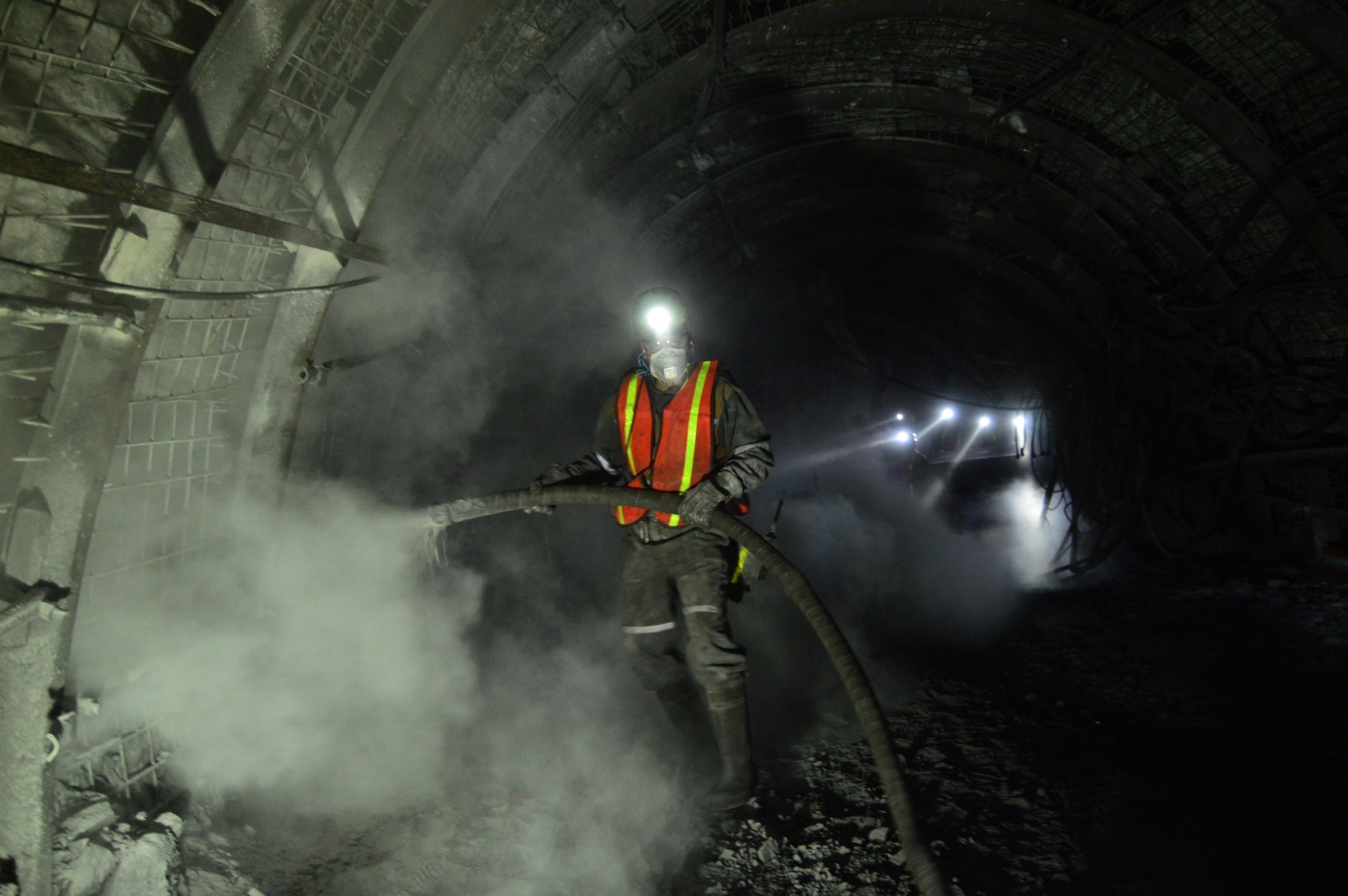
Study: CO2-Modified Bentonite-Based Multifunctional Sealing Material for Carbon-Negative Mine Fire Prevention and Gas Sequestration. Image Credit: Carlos Tovar Photographer/Shutterstock.com
Researchers have developed a CO2-modified bentonite sealing material that combines coal-mine fire protection, gas sealing, and permanent mineral-carbonation CO2 capture in a single system. The material reached 37.9 MPa compressive strength, 186 seconds of fire resistance, cut average O2 from 13.7% to 4.9%, and sequestered 24.4–40.4 kg CO2 per ton after 28 days.
A study published in Applied Sciences presents a multifunctional sealing material designed to address coal mine-fire prevention, gas leakage, and carbon management at the same time. The optimized formulation achieved a 28-day compressive strength of 37.9 MPa and a standardized fire resistance limit of 186 seconds in an alcohol-blowtorch test. The study highlights the potential of multifunctional sealing materials to improve underground mine safety while supporting more sustainable, lower-carbon mining practices.
Click here to download a free PDF copy of this page
Developing a Multifunctional Mine-Sealing Material
Coal spontaneous combustion remains a significant safety concern in underground coal mines. The process begins when oxygen reacts with reactive coal surfaces, generating heat. If this heat accumulates faster than it can be dissipated into the surrounding rock and mine atmosphere, the coal temperature progressively increases and may eventually lead to ignition. Limiting oxygen ingress into goaf areas is therefore a critical component of mine fire prevention.
Conventional sealing materials, however, have several limitations that can reduce their long-term effectiveness. Cement-based materials are susceptible to shrinkage and cracking over time, creating pathways for air and gas leakage. Organic polymer foams may also deteriorate or lose performance when exposed to elevated temperatures. In addition, most conventional sealing materials provide little or no contribution to carbon management.
To address these limitations, the study develops a multifunctional sealing material that integrates fire resistance, gas sealing, and CO2 mineralization within a single formulation. Bentonite was selected as a key component because of its swelling, adsorption, and colloidal properties, which support effective sealing performance. The study characterizes the material as comparatively carbon-negative, as its measured carbon uptake offsets a portion of its cradle-to-gate emissions relative to the cement-based benchmark.
Engineering the Material and Testing Its Performance
The researchers first treated natural sodium bentonite at 2.0 MPa CO2 pressure and 60 °C for four hours. This treatment increased the spacing between clay layers and introduced carbonate species into the material. They also prepared the Municipal Solid Waste Incineration (MSWI) slag through weathering, crushing, drying, and ball milling. The zeolite came from a CO2-capture system and contained 4 mmol of CO2 per gram.
The team prepared 11 formulations by gradually replacing cement with MSWI slag. They then adjusted the zeolite content, water-to-binder ratio, and proportions of the main and auxiliary components. The optimized formulation used 50% MSWI slag replacement and 10% CO2-saturated zeolite. It also used a water-to-binder ratio of 0.60 and a main-to-auxiliary ratio of 1:0.5.
The researchers used several analytical techniques to examine the material. X-ray fluorescence helped determine its chemical composition. Fourier-transform infrared spectroscopy (FT-IR) and X-ray diffraction (XRD) identified chemical bonds and mineral phases.
The team also tested fluidity, setting time, compressive strength, splitting tensile strength, and fire resistance. They evaluated gas-sealing performance in a simulated goaf containing crushed coal. Carbon uptake was measured through total inorganic carbon analysis. Thermogravimetric analysis and mass spectrometry helped distinguish reversible CO2 adsorption from permanent mineralization. Leaching tests and 90-day monitoring provided additional information on environmental safety and durability.
CO2 Treatment Strengthens Material Performance
CO2 treatment modified bentonite structure and swelling behavior. The montmorillonite interlayer spacing increased from 12.48 to 14.79 Å, representing an 18.5% expansion. FTIR analysis detected a carbonate absorption band at 1435 cm-¹, while XRD confirmed the formation of calcite. The colloidal value of the material increased from 85 to 115 mL/3 g, while the free-swelling index decreased from 28 to 14 mL/2 g. These changes indicate that CO2 treatment helped control excessive swelling while retaining bentonite's useful properties.
The researchers also examined how MSWI slag content affected the material’s performance. Increasing slag replacement reduced fluidity and compressive strength. The team selected a 50% replacement level to increase carbon-storage potential while maintaining the required mechanical properties through formulation adjustments. The optimized material achieved a 28-day compressive strength of 37.9 ± 1.4 MPa and a splitting tensile strength of 3.8 ± 0.2 MPa.
The material showed strong fire resistance and achieved a standardized fire resistance limit of 186 ± 6 seconds in the alcohol-blowtorch test, with no flame combustion, an average flameless combustion period of 2.11 seconds, and a flame spread length of 15 mm. Gas-sealing tests showed a reduction in oxygen concentration from 13.7% to 4.9% in the simulated goaf. The hardened material recorded a low gas permeability of 2.3 × 10-¹6 m². Overall, the tests indicated that CO2 modification improved the bentonite’s dimensional stability and carbonation reactivity, while the optimized composite provided high mechanical strength, gas sealing, and fire resistance.
Under accelerated carbonation conditions, the material mineralized 24.4–40.4 kg of CO2 per ton after 28 days, equivalent to 11.3–18.8% of its calculated theoretical capacity. This result provides a quantitative measure of the material’s carbon-storage performance, although the experiments used a highly concentrated CO2 environment rather than typical mine conditions.
Toward Sustainable Mine Fire Prevention
The study demonstrates how a multifunctional sealing material can address several challenges in underground coal mining. CO2-modified bentonite improves dimensional stability and supports mineral carbonation. MSWI slag reduces the use of conventional cement while providing calcium and magnesium for CO2 storage. CO2-saturated zeolite provides an additional carbon-storage pathway. Together, these components give the material structural strength, fire resistance, gas-sealing capability, and carbon-management potential.
MSWI slag and waste-derived zeolite can serve as useful raw materials instead of becoming disposal burdens. The study also found that compressive strength increased from 37.9 MPa at 28 days to 39.8 MPa at 90 days, while oxygen concentrations remained at 4.6–5.2% during 60 days of continued monitoring.
Heavy-metal concentrations measured in the hardened material were also well below the relevant regulatory limits. However, further research is needed before large-scale application. The accelerated carbon-uptake tests used a 99% CO2 environment, which is much higher than typical mine conditions. The reported carbon-negative performance should also be viewed as a comparative result rather than evidence of net-zero or negative emissions across the full life cycle.
The 186-second fire resistance result should similarly be interpreted as performance under a standardized laboratory test rather than a prediction of how long the material would withstand an actual mine fire. Future studies should assess longer-term performance, field conditions, variations in MSWI slag composition, and realistic CO2 uptake. A full life-cycle assessment would also help quantify the material’s environmental benefits. Overall, the study offers a promising pathway toward safer, more sustainable mine fire prevention.
Journal Reference
Dong, W., Zhang, Z., et al. CO2-Modified Bentonite-Based Multifunctional Sealing Material for Carbon-Negative Mine Fire Prevention and Gas Sequestration. Applied Sciences, 2026, 16, 7966. DOI: 10.3390/app16167966. https://www.mdpi.com/2076-3417/16/16/7966
Disclaimer: The views expressed here are those of the author expressed in their private capacity and do not necessarily represent the views of AZoM.com Limited T/A AZoNetwork the owner and operator of this website. This disclaimer forms part of the Terms and conditions of use of this website.