*Important notice: This news reports on an unedited version of an accepted paper and is awaiting final editing. Therefore, the paper should not be regarded as conclusive or treated as established information.
Researchers have investigated the impacts of freeze-thaw weathering, pre-existing flaws, and confining pressure on sandstone failure from a high-altitude open-pit mine in Xinjiang, China. They subjected single-flaw sandstone specimens to repeated freezing and thawing before evaluating them under triaxial compression, and found that the initial flaw does not inherently determine the final macroscopic failure band. Their findings were published in Scientific Reports.
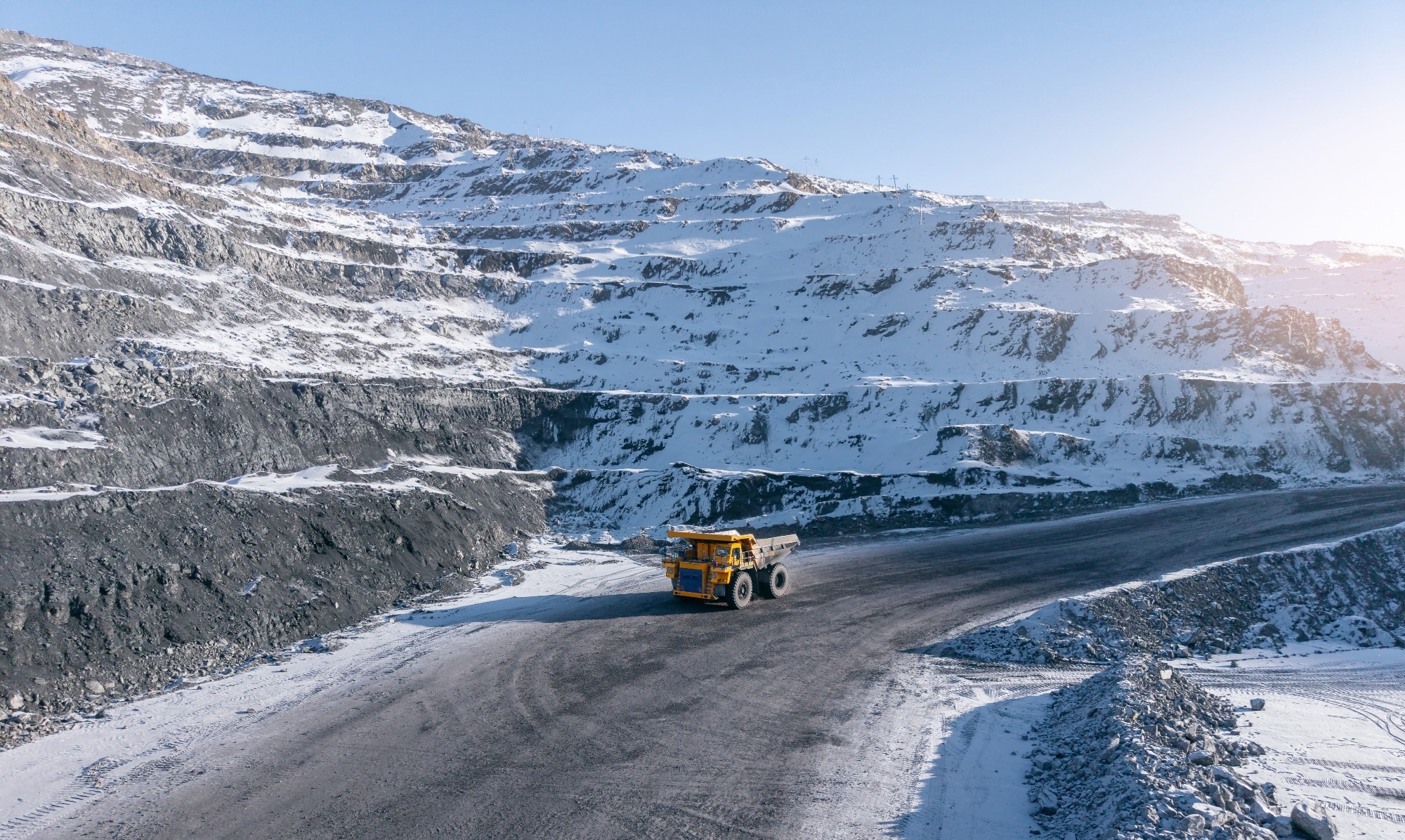 Study: Failure mechanisms and paths of freeze–thaw-treated single-flaw sandstone under triaxial compression in ultra-high-altitude cold-region open-pit mine slopes. Image Credit: Parilov/Shutterstock.com
Understanding Failure in Freeze-Thaw-Affected Mine Slopes
Ultra-high-altitude open-pit mine slopes experience repeated temperature changes, freeze-thaw weathering, and excavation-induced stress redistribution. These effects become quite important when rock masses contain pre-existing discontinuities. Freeze-thaw cycles can alter pore structure, grain contacts, and cementation, while excavation changes the local stress environment around slope structures.
The researchers focus on sandstone from the Dahongliutan mining area in Hotan County, Xinjiang, located at an elevation of about 5074 m. The study examines how a single pre-existing flaw influences failure after freeze-thaw treatment and subsequent triaxial loading. The researchers consider two flaw inclinations, 45° and 80°, together with different confining pressures and freeze-thaw histories.
Previous studies have examined the effects of flaw geometry, confinement, freeze-thaw damage, and acoustic emission separately. However, less attention has been paid to how a flaw behaves after compression closes it, converting it into a contact interface that can still influence the final failure path.
The researchers therefore combine failure morphology, stress transformation, and acoustic-emission (AE) timing to develop a framework for understanding competing failure paths in freeze-thaw-treated flawed sandstone.
Preparing Flawed Sandstone for Triaxial Testing
The researchers prepared cylindrical sandstone specimens with an average diameter of about 50.2 mm and a height of 99.6 mm. They
introduced a through-going single flaw with a nominal length of 20 mm and a width of 2 mm using water-jet cutting. The flaw formed an angle of either 45° or 80° with the loading direction.
The specimens underwent 0, 20, 40, or 60 freeze-thaw cycles. Each cycle consisted of eight hours of air freezing at -20 °C followed by eight hours of water thawing at 20 °C. The researchers measured specimen mass and P-wave velocity at intervals during the treatment.
After the prescribed cycles, they oven-dried the treated specimens at 105 °C for eight hours before testing. The untreated specimens remained in their natural moisture condition. This difference in moisture and drying history limits direct separation of freeze-thaw effects from moisture-history effects.
The team conducted conventional triaxial compression tests at confining pressures of 5, 10, and 15 MPa. They applied axial displacement at 0.2 mm/minute and continued loading through clear post-peak failure.
Six AE sensors recorded fracture activity throughout the tests. The researchers divided the loading process into six stages based on peak deviatoric stress and compared the proportions of AE hits and waveform energy occurring near peak failure.
Flaw Inclination Controls Competing Failure Paths
The mechanical results show that confinement and flaw inclination interact with freeze-thaw history in a condition-dependent manner. For specimens exposed to 20 freeze-thaw cycles, the 45° flaw produced peak deviatoric stresses of 69.88, 120.26, and 149.52 MPa at confining pressures of 5, 10, and 15 MPa, respectively.
The corresponding 80° specimens reached 86.79, 179.87, and 107.14 MPa. The non-monotonic response at 80° shows that confinement does not produce a universal strength trend across all tested conditions.
Flaw inclination strongly influenced the resulting failure morphology. The 45° specimens commonly developed oblique failure features and flaw-tip interactions. In some cases, cracks approached the flaw, deflected near its tip, and formed a through-going failure band.
In others, the final macroscopic band developed away from the original flaw through a new oblique matrix path. At 80°, failure followed near-axial paths, with some specimens developing oblique or parallel cracks that formed wider failure bands. This behavior reflects the stronger normal-compression component acting across the steeper flaw.
The researchers describe failure as a sequence of interacting processes. Freeze-thaw treatment first modifies the structural condition of the sandstone before triaxial loading closes the initial flaw and creates a contact interface.
Load transfers through this interface toward the surrounding matrix and flaw tips, where competing cracks develop. AE activity remained limited during early loading but increased as peak stress approached.
With 40 freeze-thaw cycles, an 80° flaw, and 15 MPa confinement, 41.44% of AE hits occurred during the near-peak stage and 49.55% during the peak and initial post-peak stage.
Waveform energy showed a stronger concentration, with 94.31% occurring during the latter stage. AE hit counts indicate the frequency of fracture activity, while waveform energy reflects the concentration of stronger instrument-recorded AE signals.
Download a free copy of this page here!
Toward Safer Cold-Region Open-Pit Mining
The study shows that the final failure path in freeze-thaw-affected mine slopes depends on how the flaw interacts with the surrounding rock under compression. The flaw can close and form a contact interface that redistributes load into the surrounding rock. Its inclination then influences whether failure follows flaw-related or matrix-dominated paths.
Steep discontinuities experience stronger normal compression, promoting load transfer into the surrounding matrix and encouraging near-axial failure. Lower flaw inclinations generate greater tangential action, increasing the likelihood of flaw-tip interaction, oblique crack growth, and path deflection.
These differences can help assess local failure around discontinuities in high-altitude open-pit slopes. The analysis provides a first-order interpretation but does not capture local effects such as roughness, friction, partial contact, and three-dimensional flaw-tip stresses. The laboratory conditions also differ from the coupled thermal, seepage, and excavation-induced stresses in actual mine slopes.
Overall, freeze-thaw history establishes the structural condition, flaw inclination controls the normal-shear balance, and confinement influences flaw closure and matrix cracking. Together, these factors influence which crack path develops into a macroscopic failure band.
Journal Reference
Xiong, H., Zhang, Z., et al. (2026). Failure mechanisms and paths of freeze–thaw-treated single-flaw sandstone under triaxial compression in ultra-high-altitude cold-region open-pit mine slopes. Scientific Reports. DOI: 10.1038/S41598-026-73655-9. https://www.nature.com/articles/s41598-026-73655-9.
Disclaimer: The views expressed here are those of the author expressed in their private capacity and do not necessarily represent the views of AZoM.com Limited T/A AZoNetwork the owner and operator of this website. This disclaimer forms part of the Terms and conditions of use of this website.