Gallium and germanium are two crucial yet lesser-known metals used in chips, lasers, and fiber-optic cables that enable modern communication and defense systems. The United States and the European Union both classify them as critical minerals, and governments are now treating their supply as a matter of economic security. The challenge to secure these metals begins underground, as neither forms rich deposits that can be mined profitably on its own.
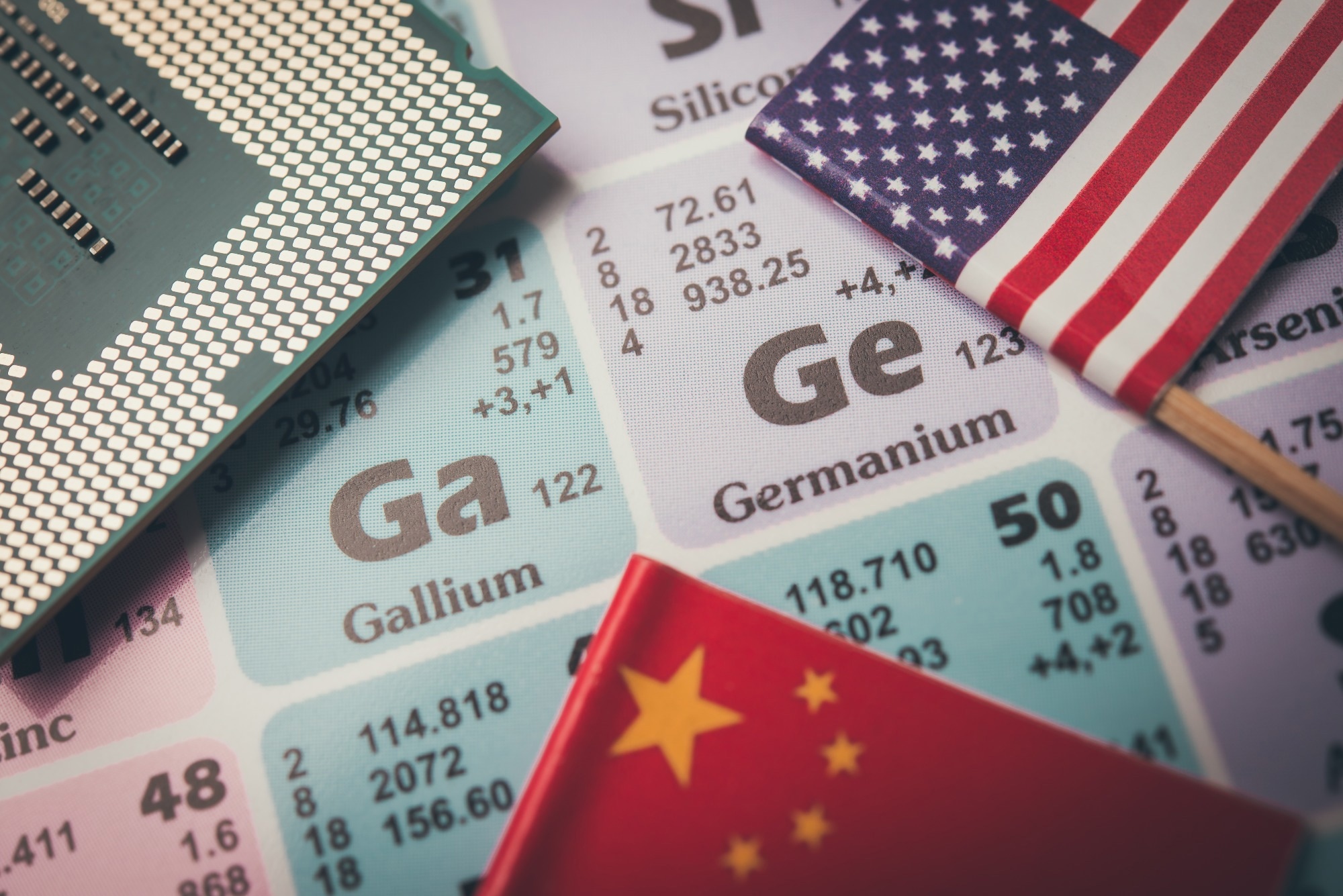
Image Credit: Pla2na/Shutterstock.com
Why Do Chips and Optics Depend on These Metals?
Gallium arsenide and gallium nitride are both crucial compounds in electronics, as they can handle more power than regular silicon and move electrons faster. These qualities make them ideal for use in the radio-frequency chips found in phones, military radar systems, and fast-charging power converters.2
In the United States, integrated circuits accounted for 73% of gallium consumption in 2025, while optoelectronic devices such as laser diodes, light-emitting diodes (LEDs), photodetectors, and solar cells accounted for 26%.2
The majority of germanium use is in optics. Manufacturers use germanium dioxide and germanium tetrachloride to produce the glass for fiber-optic cables, which accounts for the largest share of germanium use in the United States.3
Germanium metal can also transmit infrared light, making it useful for lenses in thermal cameras and night vision systems. Additionally, germanium wafers serve as the basis for multijunction solar cells that power satellites.3
There are a few substitutes for these materials: for example, silicon can replace gallium arsenide in some solar and handset applications, and chalcogenide glass can replace germanium in certain thermal imaging lenses. However, for many defense electronics, the US Geological Survey reports no effective substitute for gallium arsenide or gallium nitride.2
Recovery as Byproducts of Aluminum and Zinc
Gallium is found in bauxite, the reddish ore used to produce aluminum, at about 50–57 ppm. Most of the primary gallium, between 90% and 96%, comes from the caustic liquor used in the Bayer
process, which turns bauxite into alumina, with the rest coming from the residues left after refining zinc. Even when recovery occurs, only about 21% of the gallium in processed bauxite is successfully extracted.1
Germanium follows a similar path through zinc and coal. It can be found in sphalerite, the main zinc mineral, and in some lignite coal deposits.3
The byproduct status of gallium and germanium links their supply to decisions made in other industries. An alumina refinery operates primarily to meet the demand for aluminum; therefore, increased demand for gallium alone cannot justify additional bauxite processing.1
This misalignment is one reason why many host facilities skip gallium recovery altogether.
Historical production data from 2000 and 2021 suggests that substantial quantities of gallium have remained unrecovered during the processing of bauxite and other host materials. This reflects the economic challenges of recovering a relatively low-concentration byproduct when market demand and prices do not justify additional processing.2
Refining Capacity Sits Largely in One Country
In 2025, China produced 99% of the world’s primary low-purity gallium, totaling about 900 tons, and held about 1600 of the 1700 tons of global production capacity. The remaining supply primarily came from Japan and Russia.2
Low prices forced other producers out of the market. Germany, Hungary, and Kazakhstan stopped primary gallium production between 2013 and 2016, and the United States has recovered none since 1987.1
Researchers at Lawrence Berkeley National Laboratory estimate that new North American recovery plants would produce gallium at about $422–509/kg, well above the $122/kg price in 2016.1 This marked increase illustrates the economic challenges that have historically discouraged investment in alternative production methods.
Germanium refining is similarly narrow. China controls around 60% of refined germanium, and the United States produces less than 2% of the world's supply.4 Converting zinc residues into semiconductor-grade germanium requires extensive processing, and the small size of the global market makes new refineries hard to finance. Investors also face the risk that a dominant producer could raise output and lower prices once a competitor opens.3,4
Trade Restrictions Turned Concentration into Leverage
China has converted its dominance in refining into policy, requiring export licenses for gallium and germanium since August 2023.5,6
In December 2024, Beijing banned shipments of both metals to the United States outright, while maintaining licensing for other destinations. The ban followed American restrictions on sales of advanced chips and chipmaking equipment to China, which placed critical minerals at the center of the technology dispute.5,6
Download a free copy of this page here!
The effects showed up quickly in trade data and market prices. Chinese germanium metal exports through September 2025 fell to 7520 kg, down from 36,656 kg in the same period of 2023. Concurrently, American imports of germanium metal dropped 67% in 2025, to about 7000 kg. European prices for high-purity germanium metal climbed from $3150 to $5380/kg between January and October 2025.3
In November 2025, China suspended the ban on American exports until November 27, 2026. However, companies still need to meet licensing requirements, and this deadline is just a few weeks away.
Recycling offers limited relief in the meantime. Secondary sources supply at most 10% of gallium, and recovering these metals from chips is complex because they are combined with other materials. Recovery rates are also low, and costs are not competitive with the primary supply.5,6
Conclusion
Gallium and germanium are difficult to secure because every stage of their supply chain narrows the options. They are often byproducts of other operations, notably aluminum and zinc processing; they require careful purification; and refining has become concentrated in lower-cost areas.1–3
Export controls have shown how quickly this concentration can disrupt global manufacturers of chips, fiber networks, and infrared systems. Meanwhile, recycling is not sufficiently advanced to close the gap.1-3
The feedstock required to change this situation already exists, but goes unused: a single gallium plant attached to an existing alumina or zinc facility could significantly contribute to American demand. In acknowledgment of this, the Department of Energy has started funding initiatives to recover gallium and germanium from existing industrial processes. Going forward, the constraint lies in building refining capacity that can survive price fluctuations.1,2
References and Further Reading
- Wesselkaemper, J. et al. (2025). Enhancing supply resilience for critical materials: Case study of gallium supply in the United States. Resources, Conservation and Recycling, 222. DOI:10.1016/j.resconrec.2025.108436. https://www.sciencedirect.com/science/article/pii/S0921344925003143
- Schnebele, E. K. (2026). Mineral Commodity Summaries 2026: GALLIUM. USGS. https://pubs.usgs.gov/periodicals/mcs2026/mcs2026-gallium.pdf
- Tolcin, A. C. (2026). Mineral Commodity Summaries 2026: GERMANIUM. USGS. https://pubs.usgs.gov/periodicals/mcs2026/mcs2026-germanium.pdf
- Baskaran, G. & Schwartz, M. (2024). From Mine to Microchip: Addressing Critical Mineral Supply Chain Risks in Semiconductor Production. [Online] Center for Strategic & International Studies. Available at: https://www.csis.org/analysis/mine-microchip
- China halts ban on gallium, germanium, antimony exports to US, but controls remain. (2025). [Online] Engineering News. Available at: https://www.engineeringnews.co.za/article/china-halts-ban-on-gallium-germanium-antimony-exports-to-us-but-controls-remain-2025-11-10
- Valverde-Carbonell, J. (2024). China Has Banned US Exports of Key Minerals for Computer Chips – Leaving Washington with Limited Options. [Online] UNU-MERIT. Available at: https://unu.edu/merit/article/china-has-banned-us-exports-key-minerals-computer-chips-leaving-washington-limited
Disclaimer: The views expressed here are those of the author expressed in their private capacity and do not necessarily represent the views of AZoM.com Limited T/A AZoNetwork the owner and operator of this website. This disclaimer forms part of the Terms and conditions of use of this website.