R-evolution, Hexagon’s green-tech subsidiary, has launched its first missions deploying advanced hybrid airborne imagery and LiDAR (Light Detection and Ranging) technology. This milestone supports reclamation efforts within the extractive industry and marks a key phase of the Hexagon Green Cubes initiative.
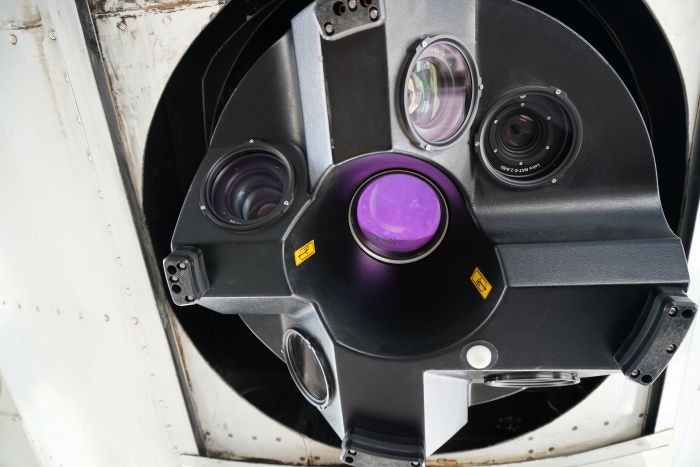 Image Credit: Hexagon AB
Green Cubes – a digital twin capturing the complexities of natural environments – integrates multiple reality capture technologies, including satellite and airborne LiDAR and imagery, terrestrial LiDAR, camera traps, acoustic sensors, and ground-penetrating radar. The solution provides the extractive industry with an integrated 3D environmental monitoring system. These insights are presented through an AI-powered Green Cubes platform, offering a “digital window” into forest ecosystems.
Powered by Leica Geosystems’ hybrid airborne system, which simultaneously captures high-resolution imagery and LiDAR, the flights will map more than 20 square kilometers to generate a digital twin of natural habitats around mining assets, protected areas, and their surrounding landscapes.
The system produces high-density point clouds with more than 40 points per square meter, enabling highly detailed 3D modelling of forest structure. This level of precision provides accurate insight into environmental conditions – from large trees to ground-level vegetation – and can detect even the smallest branches. These digital twins can support mining companies in monitoring biodiversity, assessing rehabilitation progress, and managing sustainability efforts with greater accuracy, while also creating new opportunities for community engagement and educational initiatives that promote long-term resource mobilization.
“Green Cubes is redefining how the extraction industry approaches environmental responsibility – providing transparency from space to the roots,” said Erik Josefsson, President of Hexagon’s R-evolution. “By embedding Green Cubes digital reality into the mining life cycle, we’re enabling our mining partners to accelerate restoration, improve compliance, and unlock new value through natural capital.”
Vale, one of the world’s largest iron ore producers, is already deploying Green Cubes at its Mina de Águas Claras site near Belo Horizonte, Brazil. This 1,908-hectare closed mine, now undergoing repurposing, has already seen notable environmental monitoring results: the first Puma concolor sighting in 10 years, the first recorded maned wolves on video at the site, and 146 bird species identified over 90 days using AI-enhanced camera and sound traps. Now, with the new airborne LiDAR flights, the entire 20 km2 area will be mapped in full 3D at 10-centimeter resolution.
To further connect with younger generations through education and gamification, Green Cubes is now also integrated into the open world game Minecraft. By recreating parts of the mining site within the game, players can explore nature, learn about biodiversity, and understand the role of miners in reclamation and restoration. In its initial test, a portion of the mine site was recreated on the Minecraft Agonia server, hosting 14,000 individual players.
Green Cubes is also gaining traction with Samarco, another major iron ore producer. The solution is currently deployed in Gaio and Horto Alegria, with potential expansion into wider areas and additional applications.