Advance Metals has strengthened the case for a larger polymetallic mineralized system at its Gavilanes Silver Project in Mexico after intersecting its strongest combined silver-gold-copper interval to date beneath high-grade near-surface silver mineralization.
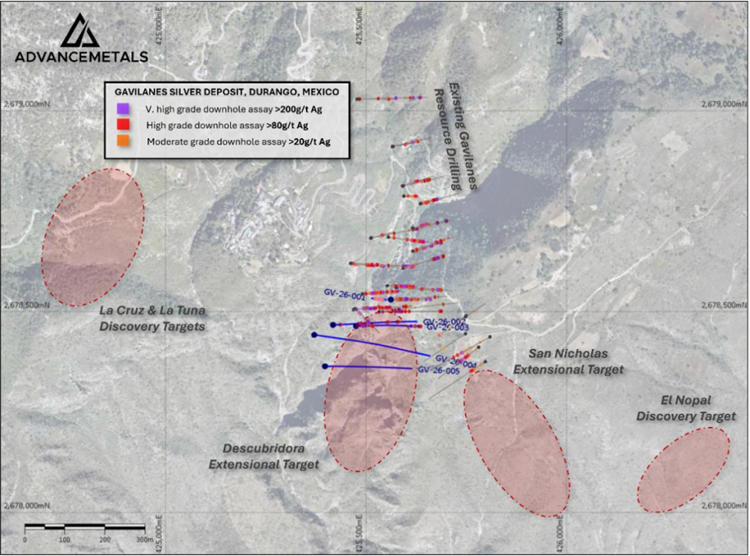 Plan view of the Gavilanes Project showing previous drill holes with downhole silver grades5 along with Advance’s key drilling targets. The location of recent AVM drill holes GV-26-001 to GV-26-005 are also shown on the plan. Image Credit: Advanced Metals Limited
The latest diamond drill hole, GV-26-003, delivered two shallow zones of high-grade silver before intersecting a broad polymetallic interval that remained mineralized to the end of the hole, leaving the system open at depth and providing a priority target for follow-up drilling.
The result marks another step forward in Advance's maiden drilling campaign at the 100%-owned Gavilanes Project, where recent drilling is progressively defining both a shallow, silver-dominant system and a deeper zone containing increasing copper and gold mineralization. Together, the latest assays reinforce the company's interpretation that the project may host a vertically stacked mineralized system with scope for further expansion through drilling.
Among the headline results, GV-26-003 returned 15.6 meters at 309 g/t silver from 24 meters, including 3.4 meters at 569 g/t silver, together with a second shallow silver interval of 6 meters at 204 g/t silver. At depth, the hole intersected 37.5 meters grading 83 g/t silver, 0.8 g/t gold and 0.6% copper, alongside zinc and lead, representing the strongest combined polymetallic interval reported from the project to date. Importantly, the lower mineralized zone continued to the end of the hole after drilling was halted short of its planned depth, leaving the system open for future testing.
The latest intercept also builds on results from the previous hole, GV-26-002, which intersected a broad copper-silver-gold zone at depth. Viewed together, the two holes provide increasing evidence that copper and gold mineralization may strengthen beneath the shallow silver system, while helping refine Advance's geological understanding of the southern end of the deposit.
Gavilanes is located in Mexico's Durango State, approximately 23 kilometers east of the San Dimas mining district. Advance said the geological setting shares similarities with the nearby district in terms of mineralization style, although the company noted this comparison relates only to geological interpretation and should not be taken as an indication of comparable size, grade or economic potential.
Commenting on the results, Advance Metals Managing Director and CEO Dr. Adam McKinnon said:
"GV-26-003 is an important result for Advance, returning two shallow high grade silver zones together with the strongest polymetallic interval reported at Gavilanes to date. The 37.5 meter lower zone contains significant silver, gold and copper mineralization and continues to the end of the hole, leaving the lower zone completely open and providing a clear target for follow-up drilling."
"Together with the broad copper-silver-gold interval intersected in GV-26-002, the latest results strengthen our interpretation of a vertically stacked system, with shallow silver-dominant mineralization and increasing copper and gold at depth. Additional drilling is required to establish the continuity and geometry of these zones, but a consistent pattern is beginning to emerge across the southern end of the system."
"With assays pending from GV-26-004 and our largest southern step-out now underway with GV-26-005, I am excited to see how the scale of the system could expand in the near-term. These results will be incorporated into the evolving geological model ahead of the planned JORC Mineral Resource upgrade in early Q4 2026."
Drilling remains underway at Gavilanes, with assays pending from hole GV-26-004 and the larger southern step-out hole GV-26-005 currently in progress. Beyond the Descubridora structure, Advance plans to test additional priority targets including San Nicolas, El Nopal and La Cruz/La Tuna, while integrating new geological and assay data into an updated geological model ahead of a planned JORC Mineral Resource upgrade targeted for early Q4 2026.