Swarm robotics inspired by the collective behavior of ants and honeybees could be used to improve the efficiency of automated mining operations. Researchers from Adelaide University designed and experimentally evaluated three bio-inspired robotic strategies for transporting ore along simulated mine haul routes. The results, published in Natural Sciences, suggest that decentralized swarm intelligence can improve productivity, reduce energy consumption, and enhance operational safety in future terrestrial and space mining systems.
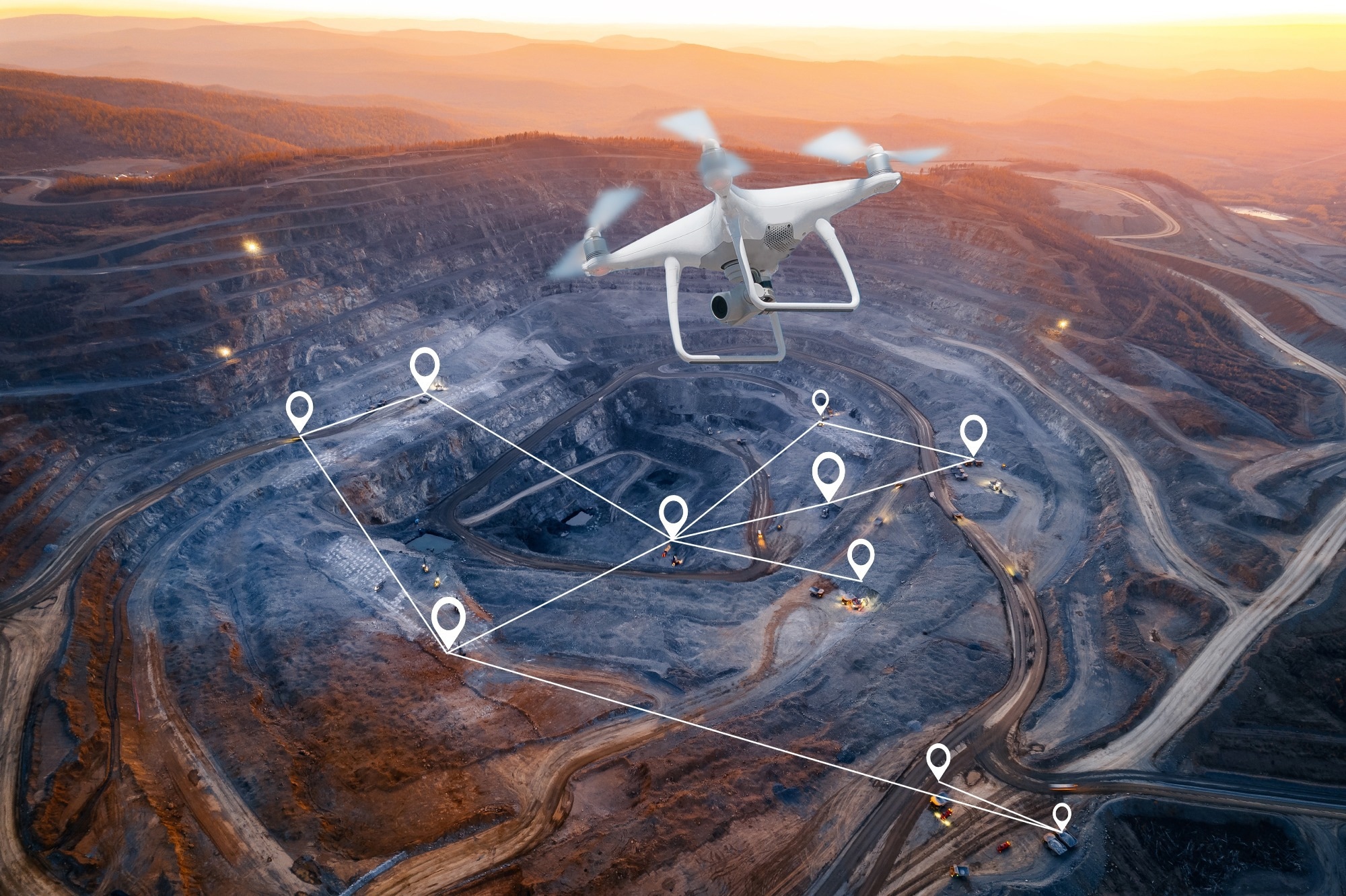 Study: Bio-Inspired Swarm Robotics Design for Mine Automation. Image Credit: Parilov/Shutterstock.com
Advancing Mine Automation with Swarm Robotics
Mining operations are becoming increasingly complex as companies expand into deeper and more remote deposits, driving demand for efficient, safe, and cost-effective automation.
Autonomous haulage systems have improved operational efficiency and reduced worker exposure to hazardous conditions. However, most existing systems rely on centralized control architectures, which can limit adaptability and responsiveness in dynamic mining environments.
Saving this for later? Download now!
Swarm robotics offers an alternative approach inspired by the collective behavior of social insects. Species such as leafcutter ants and honeybees coordinate complex activities through decentralized decision-making, enabling colonies to adapt efficiently without centralized control. These biological principles have inspired swarm robotic systems, in which multiple autonomous robots cooperate through simple local interactions to accomplish shared tasks.
Although previous studies have extensively investigated swarm-based mining strategies through computational simulations, experimental validation using physical robotic platforms remains limited. To address this research gap, the researchers designed and experimentally evaluated three bio-inspired swarm robotics strategies for autonomous ore transport using a laboratory-scale platform that replicates key characteristics of mine haul routes.
Experimental Evaluation of Swarm Robotics
The researchers developed three autonomous robotic strategies using Pololu Zumo 2040 robots on a scaled laboratory platform designed to replicate single-lane mine haul roads. The ‘baseline’ strategy relied on a single robot that searched for ore, collected it, and immediately returned to the base after each discovery.
The ‘ant strategy’ divided the workload between two robots: one explored the haul route and collected ore, while the other transported the material back to the base.
The ‘honeybee strategy’ adopted a different approach. It first explored the entire route to identify and memorize all ore locations before planning an optimized collection sequence.
To compare the three approaches, the team conducted 250 experimental sets, repeating each test at least five times to ensure consistent results. They varied the number of robots, haul-road length, ore quantity, and ore distribution to evaluate how each factor influenced system performance. The analysis focused on three key metrics: ore delivery time, total travel distance, and estimated energy consumption.
The researchers also assessed several practical factors that could influence real-world deployment. They examined the effects of sensor calibration, battery limitations, mechanical alignment, robot-to-robot communication, and other hardware constraints to better understand how physical systems perform outside computer simulations.
Harnessing Swarm Intelligence for Smarter Mining
The honeybee-inspired strategy consistently outperformed the baseline and ant approaches across nearly all experimental conditions. Its memory-based navigation system first identified every ore location before calculating an optimized retrieval route.
This approach eliminated many unnecessary return trips, reducing total travel distance by up to 80%, lowering estimated energy consumption by approximately 50%, and shortening ore delivery time by around 60% compared with the baseline strategy.
The ant strategy improved efficiency by dividing exploration and haulage between two robots. While one robot searched for ore, the other transported material back to the base, allowing both tasks to proceed simultaneously. However, frequent coordination and material handovers introduced delays, limiting the system's overall performance compared with the honeybee approach.
The experiments also revealed several practical challenges that simulation studies often fail to capture. Sensor noise, battery depletion, mechanical misalignment, and communication delays all affected robot performance, reducing some of the predicted efficiency gains. The honeybee-inspired strategy maintained a clear performance advantage, demonstrating its potential to improve the efficiency and reliability of future autonomous mining systems.
Toward Smarter Autonomous Mining Systems
This study highlights the potential of bio-inspired swarm robotics to improve the efficiency and flexibility of autonomous mining operations. Decentralized swarm control enables multiple robots to work collaboratively, improving the efficiency of exploration, ore collection, and material transport while reducing travel distance, energy consumption, and operational delays.
The results also show that different swarm strategies could suit different mining environments. The baseline approach could support simple operations that require rapid ore delivery, while the ant strategy could be employed for medium-scale mines where separating exploration and haulage tasks is involved. The honeybee-inspired strategy proved most effective in large and complex mining environments where optimized route planning significantly improved transport efficiency.
Researchers recommend validating the algorithms on larger robotic platforms and under realistic operating conditions before these systems can be deployed in active mines. Future studies should evaluate their performance on multi-lane haul roads, rough terrain, uneven ore distributions, and in the presence of dust, communication delays, and other environmental challenges.
The researchers also suggest that memory-based swarm control could support autonomous resource extraction during future lunar or asteroid mining missions. Overall, the study demonstrates how principles inspired by social insects can address real engineering challenges, paving the way for safer, more efficient, and more resilient autonomous mining systems.
Journal Reference
Tan, J., Melkoumian, N., et al. (2026). Bio-Inspired Swarm Robotics Design for Mine Automation. Natural Sciences. 6(2). https://onlinelibrary.wiley.com/doi/10.1002/ntls.70049.
Disclaimer: The views expressed here are those of the author expressed in their private capacity and do not necessarily represent the views of AZoM.com Limited T/A AZoNetwork the owner and operator of this website. This disclaimer forms part of the Terms and conditions of use of this website.