Altoro Metals Limited has confirmed zinc sulfide mineralization at depth at its Guajaraz Project in central Spain, as its maiden diamond drilling program advances into the western and deeper portions of the historical La Unión mining system.
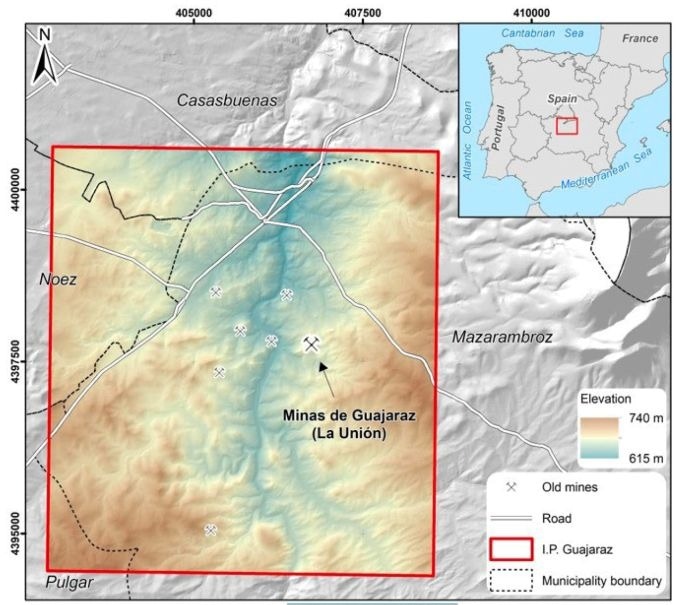 Guajaraz location map. Image Credit: Altoro Metals Limited
Altoro has completed three holes at Guajaraz, with two further holes in progress as the company uses results from its initial drilling to refine its understanding of the mineral system and reposition drilling towards areas considered to have greater potential for grade and scale.
The most significant geological observation to date has come from hole G-03, which intersected brown sphalerite veinlets. Sphalerite is the principal ore mineral for zinc, and its presence confirms zinc sulfide mineralization within the deeper sequence being tested by the program.
The result is important because Altoro’s drilling is not targeting the historical mine workings themselves. Instead, the company is testing the broader system around and beneath La Unión, where historical mining extended to about 280 meters depth across multiple levels and produced lead-zinc sulfide mineralization with significant historical silver credits.
The roughly 1,400-meter maiden program was designed using geological mapping, historical mine information and an 8.5 line-kilometer Deep Ground Penetrating Radar survey. Its principal objective is to test for deeper carbonate-hosted replacement-style zinc mineralization, along with structures running parallel to the historical mine.
Drilling has also provided Altoro with a more detailed picture of the geology beneath Guajaraz than was available from surface work alone.
Hole G-04 intersected the metasedimentary rock package exposed at surface before being stopped at 53.35 meters, allowing the rig to be moved quickly to the G-05 target. G-05, which had reached about 202 meters at the time of the announcement, has encountered multiple zones of strong hydrothermal alteration and low-grade mineralization on the western side of the historical system.
Altoro said the metasedimentary rocks intersected in G-04 and G-05 provide an important new constraint on its geological model and support further evaluation of the western portion of the system.
The company has cautioned, however, that the significance of the sphalerite observed in G-03 cannot be determined until laboratory analysis is complete. The subsurface geology has also proved more complex than suggested by surface exposures, with drilling encountering variations between granitoid and migmatitic rocks, metasedimentary units and gneissic rocks.
The drilling comes as zinc prices provide a supportive backdrop for exploration, with Altoro noting that the LME zinc price recently surpassed US$4,000 a ton. The company said it has been adapting drill locations as geological information becomes available, prioritizing areas it considers to have the greatest potential for significant grade and tonnage.
Attention will now turn to assays from the Guajaraz program. Core is being logged and sampled, with analytical results expected within four to six weeks.
In the meantime, drilling will continue at G-05 on the western side of the historical mine system and at G-01, which is being redrilled following a technical failure, to test the deeper geological setting.
Altoro is also progressing an application for a three-year extension to the Guajaraz exploration permit. Once G-05 is completed, one drill rig is scheduled to move to the company’s flagship Novales-Udías Zinc Project in Cantabria, where surface drilling is planned to test extensions of the established zinc-mineralized corridor.
About the Guajaraz Project
The Guajaraz Project comprises a 1,530-hectare brownfield exploration permit in the Central Zone of the Iberian Massif, encompassing parts of the Mazarambroz, Pulgar, Casasbuenas, and Noez municipalities in Toledo Province, Castilla-La Mancha, central Spain. The project takes its name from the local Guajaraz stream, which rises near Mazarambroz before eventually flowing into the Tagus river.
The project is centered on the historical La Unión (La Económica) mine near Mazarambroz and includes seven known mineral occurrences. Historical mining occurred intermittently from 1945 until the mid-1980s, with workings extending to approximately 280 m depth over ten levels. Historical records indicate production of Pb-Zn sulfide mineralization, including galena and sphalerite, with reported silver credits. Historical exploration also identified a number of additional mineralized structures and occurrences across the project area. Altoro's current exploration program follows geological mapping, geochemical sampling, and an 8.5 line-kilometer DGPR survey undertaken to identify and prioritize targets for modern exploration.
The maiden drilling program is designed to test the continuity of the mineral system at depth and along strike and to establish a modern geological framework for future exploration.