Nickel has long been essential to stainless steel production, but its role in electric vehicle batteries is becoming increasingly important. Today, the nickel market faces a supply–demand imbalance. Indonesia now accounts for more than 60 % of global production, and output has exceeded consumption through 2025, pushing prices down to levels that threaten the viability of mines in Australia and other higher-cost regions. While stainless steel still accounts for the majority of nickel worldwide, battery manufacturing is growing faster. Analysts expect this momentum to lift total demand to 4.4 million tons by 2031.1, 2
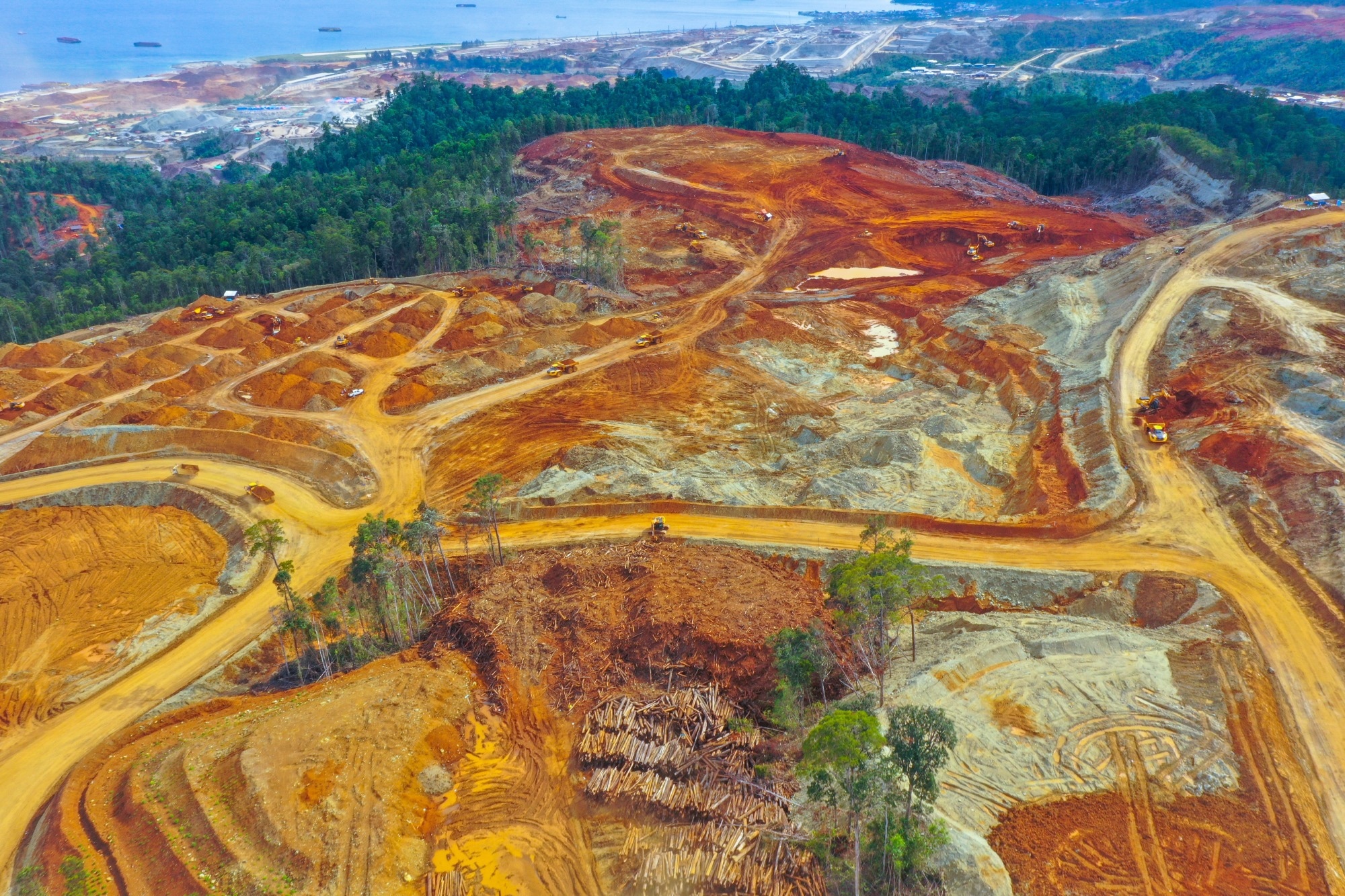
Image Credit: Nanang Sugi/Shutterstock.com
Application Areas of Nickel Mining
The nickel mining industry serves two distinct market segments with different technical requirements and growth trajectories.
Stainless steel
Stainless steel production remains the primary application, representing approximately 69 % of global nickel consumption as of 2024.3 The metal’s inherent corrosion resistance and structural integrity make it an essential component in construction, manufacturing, and industrial equipment.
Austenitic stainless steels, specifically the widely used grades 304 and 316, require a nickel content of 8-18 %. These materials are found in everything from household kitchen appliances and medical instruments to heavy-duty chemical processing equipment and architectural cladding.
Batteries
The battery sector represents the fastest-growing application segment and is the primary driver of new exploration and refining investments.
Nickel is a critical component in lithium-ion battery cathodes, particularly in nickel-manganese-cobalt (NMC) and nickel-cobalt-aluminum (NCA) chemistries. High-nickel cathode formulations, such as NMC 811, which contains 80 % nickel, enable significantly higher energy density. This increased density allows electric vehicles (EVs) to achieve extended driving ranges without the added weight of larger battery packs.4
This specific technical requirement has created robust demand for Class I nickel, defined as material with at least 99.8 % purity, the only grade that can be efficiently processed into the nickel sulfate required for battery manufacturing.
The growth rate of the battery sector continues to outpace traditional industrial applications. By late 2024, battery applications accounted for approximately 17 % of total global nickel demand, and this figure is projected to rise steadily as EV adoption accelerates across North America, Europe, and China.5
Market data indicates that NCM622 battery chemistry captured approximately 32 % of the battery market in 2024, while the more nickel-intensive NCM811 reached a 40 % market share during the same period.6
Macroeconomic Context and Regional Stability
The nickel mining market is highly sensitive to macroeconomic stability in emerging economies, which host a significant share of the world's mining and refining infrastructure. Global capital flows, including domestic financial health and external capital indicators, serve as a barometer for the industrial resilience of these regions.
Emerging market stability
The ability of mining-heavy regions to maintain the infrastructure, energy grids, and logistics necessary for mineral exports is often tied to their broader economic health. For instance, in December 2025, Pakistan reported receiving $3.6 billion in remittances.1
Although Pakistan is not a primary producer of nickel, such macroeconomic indicators reflect the financial stability and liquidity available within the broader Asian and emerging market corridors. For nations involved in the midstream processing or downstream manufacturing of nickel-dependent products, these inflows provide essential economic buffers.
Want to save this article for later? Click here.
Steady capital flows allow for the continued development of ports, power plants, and transportation networks that facilitate the movement of critical minerals. In regions like Southeast Asia, where nickel production is concentrated, overall macroeconomic stability is required to sustain the massive capital expenditures associated with new refinery projects and to navigate global commodity price shocks.1
The growth anchor
Against this backdrop of regional economic indicators, the market relies on long-term demand anchors to justify continued investment. The most prominent anchor is the forecast from Mordor Intelligence, which expects nickel market volumes to reach 4.4 million tons by 2031.2 This projection provides the strategic framework for the industry, suggesting that despite current oversupply, the fundamental trajectory is one of expansion. This long-term target encourages producers to maintain operational capacity even during periods of price suppression, anticipating the massive scale of electrification required for global net-zero targets.
Recent Developments in the Nickel Mining Market
The nickel market is currently emerging from what analysts describe as "The Great Surplus" of 2024–2025. In 2024, the market was defined by primary production outstripping consumption by approximately 179,000 tons, with total production reaching 3.53 million tons. This trend intensified in 2025, with final year-end data indicating a surplus of 198,000 tons. Global production in 2025 reached approximately 3.74 million tons, while total demand stood at 3.54 million tons.7
As of January 2026, these surplus conditions have become the primary driver of industry restructuring. Indonesia’s massive production expansion remains the central theme. In 2024, Indonesia’s mine output represented 46 % of global primary nickel production, a figure that increased through 2025.7
Indonesia successfully forced a massive "downstreaming" shift by utilizing its 2020 ban on raw ore exports. Chinese metallurgical firms have invested heavily in Indonesian High-Pressure Acid Leaching (HPAL) plants that process limonite ores to produce Mixed Hydroxide Precipitate (MHP), an essential intermediate in the battery supply chain.
This surge in low-cost supply has fundamentally transformed the competitive landscape for Western miners. The most significant structural shift occurred in October 2024, when BHP officially suspended its Nickel West operations and the West Musgrave project in Western Australia.8 As the market enters 2026, these facilities remain in a state of "care and maintenance." BHP’s decision followed a period where the division recorded consistent negative cash flow, despite having invested $3 billion to orient its production toward the EV market. The company has committed to spending approximately $300 million annually to maintain the facilities, with a formal restart review not expected until early 2027.
By early 2026, London Metal Exchange (LME) prices began to stabilize after hitting lows of $15,000 per ton in early 2025. However, the price environment remains challenging for high-cost sulfide mines, which lack the scale and integrated processing advantages of the Indonesian laterite hubs.7
Current Global Market Distribution
Indonesia continues to dominate the supply side, accounting for an estimated 63.4 % of global nickel ore production.6 China remains the world’s largest consumer, accounting for over 63 % of primary nickel consumption.7
Asia as a whole remains the center of the nickel universe, accounting for nearly 87 % of global primary nickel consumption. Although Chinese demand is still anchored by its stainless-steel sector, its domestic EV battery industry is an increasingly powerful consumer. Indonesia has also transitioned into a major nickel user. In 2025, its internal consumption rose as it developed its own downstream battery and EV manufacturing plants.7
Several major corporations dictate the market’s current posture. Vale S.A. remains a diversified global leader, maintaining significant operations in Brazil, Canada, and Indonesia. Glencore continues to manage a wide portfolio, including the Murrin Murrin mine in Australia.
In Russia, MMC Norilsk Nickel remains a critical supplier of high-grade Class I nickel, though its trade flows have shifted significantly toward Asian markets over the last two years.
Meanwhile, emerging companies are focusing on sustainability as a competitive edge. Canada Nickel Company and Talon Metals are advancing projects in Ontario and Minnesota, respectively, targeting production methods that meet the "clean" energy standards required for the U.S. and European supply chains.
Hot Topics in Nickel Mining
Supply concentration and geopolitics
The concentration of supply is a primary strategic concern in 2026. Indonesia and China together control 75 % of global finished nickel production.9 This gives Indonesia unprecedented influence over supply conditions. Throughout 2025, the Indonesian government used its permit issuance process (RKAB) to manage ore tightness, successfully supporting prices even amid a global surplus.7
The Class I nickel challenge
A structural paradox defines the 2026 market: a surplus of Class II nickel (NPI and ferronickel) coexisting with a tight supply of high-purity Class I nickel. Although producers have successfully commercialized the conversion of NPI into battery-grade matte, the high energy costs and carbon footprint of this process remain a point of contention for Western automakers seeking to lower their Scope 3 emissions.
Battery chemistry competition
The rise of lithium iron phosphate (LFP) batteries remains a critical variable. LFP chemistries contain no nickel and are cheaper to produce, having captured a significant share of the standard-range EV market in China. However, as of 2026, high-nickel chemistries continue to lead in the long-range and premium vehicle segments, where energy density is the primary consumer requirement.
Western supply chain incentives
The U.S. Inflation Reduction Act and the European Union's Critical Raw Materials Act are now in active implementation. These policies provide tax credits and subsidies for minerals sourced from domestic mines or free-trade partners. This is creating a "bifurcated" market where "IRA-compliant" nickel from Canada or Australia is positioned as a premium product, distinct from the lower-cost but higher-emission nickel produced elsewhere.
Future Directions for Nickel Mining
The 2031 growth trajectory
Market projections continue to point toward a volume of 4.4 million tons by 2031.2 Reaching this target will require the industry to move beyond the current period of care and maintenance.
Although stainless steel consumption is forecast to maintain a steady 3-4 % annual growth rate, the battery sector must overcome near-term moderation to drive the next wave of expansion.3 The International Nickel Study Group (INSG) expects primary nickel usage to grow by approximately 5 % through 2026 as the global EV market matures.7,10
Technology and green refineries
Processing technology remains a key area of innovation. HPAL is now a proven, if capital-intensive, standard for treating laterite ores.
In 2026, the focus shifted toward reducing the carbon intensity of these plants. Western producers are leveraging renewable energy, such as hydroelectric power in Canada and Finland, to produce "low-carbon nickel." The E.U.’s battery regulations, now requiring carbon footprint declarations, are expected to create a permanent premium for these low-emission sources.
Secondary production
Recycling is slowly emerging as a secondary supply source. As the first generation of EVs reaches end-of-life, hydrometallurgical recycling facilities are beginning to scale. However, given the long lifespan of modern vehicle batteries, recycled nickel is not expected to contribute more than 15 % of the total supply before 2035.10 Primary mining will remain the dominant source for the foreseeable future.
Market stabilization
If current price stabilization continues through 2026, it may encourage the resumption of suspended projects. However, the International Nickel Study Group notes that the pace of demand growth remains sensitive to consumer preferences, specifically the balance between fully electric vehicles and plug-in hybrids, which contain significantly less nickel.10
Final Thoughts
As 2026 begins, the nickel mining industry is adjusting after years of rapid production growth that created more supply than the market needed. Indonesia now produces most of the world's nickel at costs other countries find hard to match, which means traditional mining regions need to offer something different, whether that's lower emissions or alignment with Western trade policies, to stay competitive.
The forecast of 4.4 million tons by 2031 still holds, though getting there won't be straightforward.
Mining companies will need to improve their processing efficiency, cut their carbon footprint, and work within an increasingly fragmented global supply chain where different regions follow different rules. The oversupply in 2024 and 2025 made business difficult for many producers, but it also pushed the industry to rethink how nickel is extracted, processed, and sold.
References and Further Reading
- Business Recorder. (2025, January 10). Pakistan receives $3.6bn in remittances in December 2025. https://www.brecorder.com/news/40401390/pakistan-receives-36bn-in-remittances-in-december-2025
- Mordor Intelligence. (2024, October 18). Nickel market volume expected at 4.4 mn tons by 2031 on strong stainless steel and EV demand. PR Newswire. https://www.prnewswire.com/news-releases/nickel-market-volume-expected-at-4-4-mn-tons-by-2031-on-strong-stainless-steel-and-ev-demand-says-mordor-intelligence-302655112.html
- Ferreira, R., & Pinto, F. (2024, December 2). The world nickel market in 2024 – slowly diminishing surplus. Stainless Steel World. https://stainless-steel-world.net/the-world-nickel-market-in-2024-slowly-diminishing-surplus/
- U.S. Geological Survey. (2024, January). Nickel. Mineral Commodity Summaries. https://pubs.usgs.gov/periodicals/mcs2024/mcs2024-nickel.pdf
- Market.us. (2024, December 19). Nickel market size, share, growth, trends & report 2030. https://market.us/report/nickel-market/
- Shanghai Metal Market. (2025). Current status and future trends of the global nickel industry. https://www.metal.com/en/newscontent/103370053
- Ferreira, R., & Pinto, F. (2025, July 21). The world nickel market in 2025 – a growing surplus in an uncertain global landscape. Stainless Steel World. https://stainless-steel-world.net/the-world-nickel-market-in-2025-a-growing-surplus-in-an-uncertain-global-landscape/
- BHP. (2024, July 11). Western Australia Nickel to temporarily suspend operations. https://www.bhp.com/news/media-centre/releases/2024/07/western-australia-nickel-to-temporarily-suspend-operations
- Crux Investor. (2025). How Indonesia's nickel dominance & Western security concerns are reshaping investment opportunities. https://www.cruxinvestor.com/posts/how-indonesias-nickel-dominance-western-security-concerns-are-reshaping-investment-opportunities
- International Nickel Study Group. (2025, October 7). INSG press release October 2025. https://insg.org/wp-content/uploads/2025/10/pressrel_INSG-Press-Release-October_2025-nd782v78.pdf
Disclaimer: The views expressed here are those of the author expressed in their private capacity and do not necessarily represent the views of AZoM.com Limited T/A AZoNetwork the owner and operator of this website. This disclaimer forms part of the Terms and conditions of use of this website.