Water-rich asteroids are becoming important for long-term human activity in space. These ancient bodies contain water that is either bound in minerals or present as ice, which can be valuable sources for propellant, life support, and radiation shielding. Their compositions also preserve clues to early solar system processes and the delivery of volatiles to terrestrial planets. Understanding the locations of these asteroids, the amount of water they contain, and the methods for extracting that water is essential for planning exploration strategies and developing new concepts for space resources.
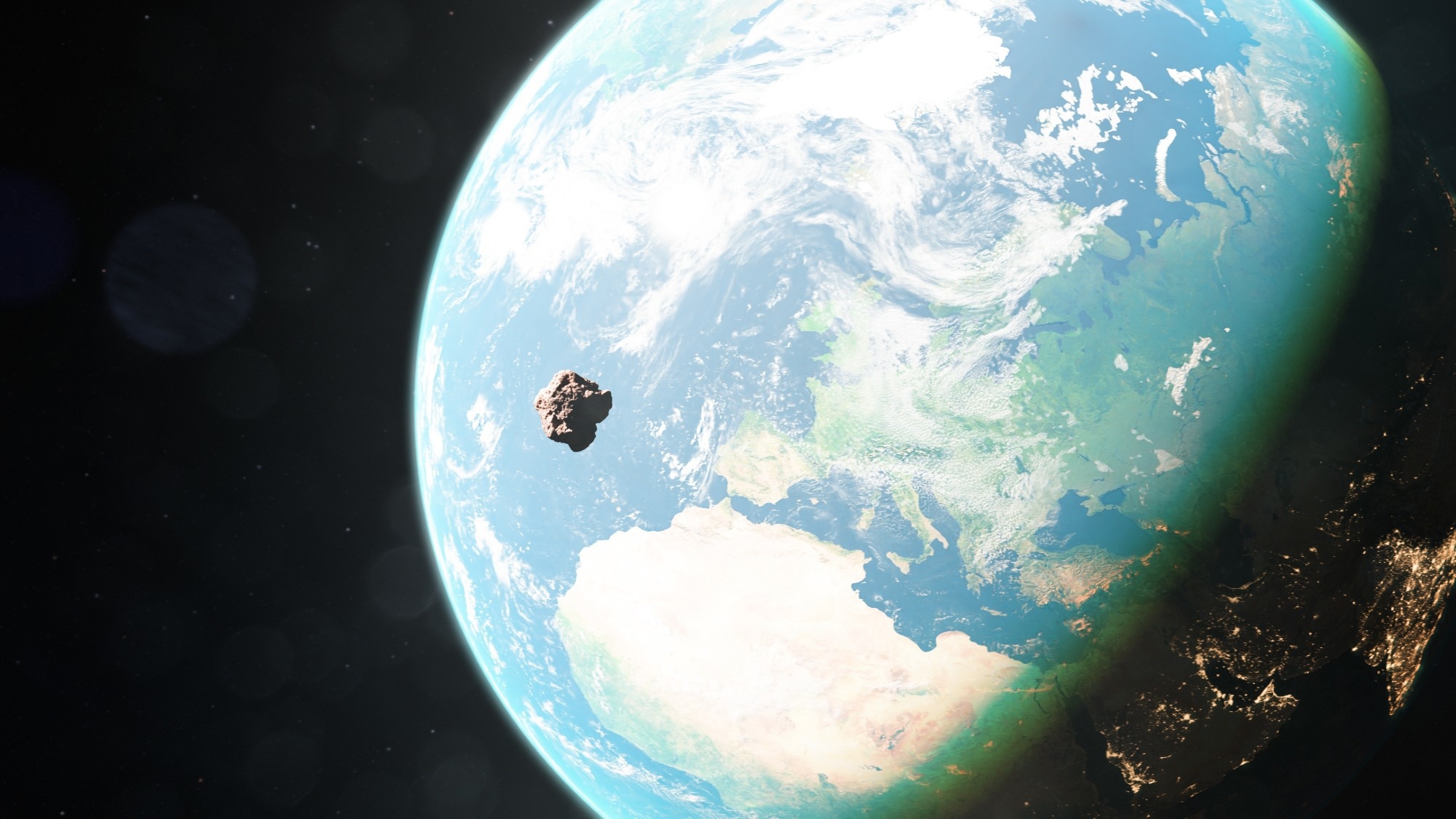
Image Credit: Format Media/Shutterstock.com
Nature of Water-Rich Asteroids
Water-rich asteroids are generally associated with C-type and related primitive classes, whose meteorite analogs are carbonaceous chondrites. These meteorites preserve ancient solar system materials, including hydrated silicates and phases that show low-temperature water-related changes on their parent bodies. CI and CM carbonaceous chondrites often contain a few weight percent of water stored in phyllosilicates. Recent studies of CM chondrites show water content ranging from 1.9 to 10.5 weight percent, with an average close to 7 percent.1,2,3
Sample-return missions have significantly improved our understanding of the representativeness of meteorites from water-rich asteroids. Material research from Ryugu and Bennu indicates that their compositions resemble those of hydrated carbonaceous chondrites. They also reveal that fine-grained regolith can contain significant amounts of bound water and organic materials. Even S-type bodies like Itokawa contain water in minerals that are usually thought to be dry, suggesting that inner-solar-system asteroids might carry more water than previously believed.1,3,4
Geochemical and Mining Potential
The geochemical context of water-rich asteroids is important for mining because water usually does not exist alone.
Carbonaceous chondrites contain transition metals, rare earth elements, and organics along with hydrated minerals. However, a recent study found that undifferentiated asteroids often do not meet Earth's ore-grade standards for many metals.
The same work shows that CV and CK chondrites have higher levels of titanium and certain rare earths compared to CI chondrites. CR and CM chondrites show unique patterns of manganese and volatile behavior. These differences reflect the history of the parent body, including collisions, brecciation, and degrees of aqueous alteration.1,5
From a mining perspective, this composition points to a tiered value structure. In the near term, water is the main target for in-space use, while metals and rare earth elements are secondary byproducts that might become attractive as in-space infrastructure matures.
A recent study published in the Monthly Notices of the Royal Astronomical Society states that some pristine asteroids with specific olivine and spinel spectral bands could be promising mining targets. However, it also notes that mass mining of undifferentiated carbonaceous bodies for metals is not yet economically viable.1,5,6,7
Want to save for later? Click here.
Role in In-situ Resource Utilization
Water-rich asteroids are a key resource for many applications.
Water is essential for life support, controlling temperatures, and producing fuel. By splitting water through electrolysis, we can create oxygen and hydrogen, which serve as a propellant for tugs in cislunar and deep-space missions.
A recent economic analysis published in Acta Astronautica suggests that using asteroid-derived water as propellant could become cost-effective between 2030 and 2050, especially for lunar orbit deliveries. This study projects several hundred tons per year of potential demand for in-space refueling if exploration architectures and commercial activity continue to expand.1,5,6,7
Water from asteroids also reduces logistical dependence on Earth launches. Propellant depots supplied by water-rich near-Earth asteroids can support tugs transporting cargo between Earth orbit, lunar orbit, and higher-energy destinations, with each kilogram of water produced in space saving multiple kilograms from Earth’s gravity well. Studies on space resource utilization highlight that these depots, along with local water and oxygen, can help create sustainable lunar bases and support missions to Mars.5,6
Technical and Operational Challenges of Water-Rich Asteroid Mining
Turning water-rich asteroids into practical resource sites requires new mining architectures for low-gravity settings with loose regolith.
A study in the Royal Astronomical Society stresses that carbonaceous asteroids are porous, brecciated, and mechanically fragile, which complicates excavation and separation of hydrated and metallic fractions.
Factors like regolith cohesion, varying degrees of lithification, and impact-generated heterogeneity affect how easily materials can be gathered, heated, and processed. These properties also influence engineering choices for anchoring systems, drills, thermal enclosures, and capture mechanisms.?1,5,7
Thermal mining concepts propose enclosing boulders or surface patches and heating them so that water vapor sublimates and is captured on cold traps or within closed systems.
Efficient designs must consider energy input, heat loss, and processing time to ensure a steady output.
Dust control and the risk of damaging weak surfaces are also important factors. Operations should incorporate remote sensing, site scouting, and real-time data to assess water content and material behavior before investing in large-scale infrastructure.1,5,6
Strategic Significance for Future Space Activity
Water-rich asteroids have strategic importance that extends beyond simple resource inventories. They preserve a geochemical archive of early solar system conditions while also offering resources that can support long-duration human and robotic exploration.
Careful chemical characterization of carbonaceous chondrites informs both mission planning and the design of technologies for low-gravity extraction and processing. This dual scientific and operational value makes sample-return missions, laboratory studies, and spectral surveys of C-complex asteroids directly relevant to future mining architectures.1
In parallel, policy and economic discussions view asteroid water as essential infrastructure rather than just a speculative resource. International roadmaps for space resource utilization identify water-rich asteroids and lunar polar volatiles as complementary testbeds, where lunar operations provide an intermediate step before fully exploiting small, low-gravity bodies.
As technologies for prospecting, thermal extraction, and in-space transportation mature, water-rich asteroids are likely to define where and how the first commercially meaningful space mining operations occur.1,5,6
Is This the Future?
Water-rich asteroids offer a viable pathway to sustainable space operations through the production of propellant and life support.
Advances in sample-return missions and geochemical analysis now provide precise data on their compositions and the challenges of extraction. Therefore, by focusing on C-type near-Earth objects, optimal targets for initial operations can be identified.
Lunar testing of thermal extraction and processing technologies will bridge current capabilities to full asteroid missions. These steps position water mining as a foundational element of cislunar economies and deep-space exploration. Strategic investment in these resources will enable humanity's expansion beyond Earth orbit.
References and Further Reading
- Trigo-Rodríguez, J. M. et al. (2025). Assessing the metal and rare earth element mining potential of undifferentiated asteroids through the study of carbonaceous chondrites. Monthly Notices of the Royal Astronomical Society, 545(1). DOI:10.1093/mnras/staf1902. https://academic.oup.com/mnras/article/545/1/staf1902/8317164
- Hamilton, V. E. et al. (2021). Meteoritic evidence for a Ceres-sized water-rich carbonaceous chondrite parent asteroid. Nature Astronomy. DOI:10.1038/s41550-020-01274-z. https://www.nature.com/articles/s41550-020-01274-z
- Lee, M. R. et al. (2023). The water content of CM carbonaceous chondrite falls and finds, and their susceptibility to terrestrial contamination. Meteoritics & Planetary Science, 58(12), 1760-1772. DOI:10.1111/maps.14099. https://onlinelibrary.wiley.com/doi/10.1111/maps.14099
- Chan, Q. H. et al. (2021). Organic matter and water from asteroid Itokawa. Scientific Reports, 11(1), 5125. DOI:10.1038/s41598-021-84517-x. https://www.nature.com/articles/s41598-021-84517-x
- Cilliers, J., Hadler, K., & Rasera, J. (2023). Toward the utilisation of resources in space: Knowledge gaps, open questions, and priorities. Npj Microgravity, 9(1), 22. DOI:10.1038/s41526-023-00274-3. https://www.nature.com/articles/s41526-023-00274-3
- Colvin, T. J. et al. (2020). Assessing the economics of asteroid-derived water for propellant. Acta Astronautica, 176, 298-305. DOI:10.1016/j.actaastro.2020.05.029. https://www.sciencedirect.com/science/article/abs/pii/S009457652030312X
- Mining asteroids for water and metals explored. (2026). Royal Astronomical Society. https://ras.ac.uk/news-and-press/research-highlights/mining-asteroids-water-and-metals-explored
Disclaimer: The views expressed here are those of the author expressed in their private capacity and do not necessarily represent the views of AZoM.com Limited T/A AZoNetwork the owner and operator of this website. This disclaimer forms part of the Terms and conditions of use of this website.