Mining operations, which extract valuable minerals and resources from the earth, produce significant waste and pollution that can have devastating effects on surrounding ecosystems and communities. For instance, coal mining activities generate considerable acid mine drainage (AMD), a toxic byproduct that significantly threatens the quality of surface water and groundwater and public health across mining regions worldwide.1 This article explains why tackling ADM is critical and outlines the measures being implemented to address this mining issue.
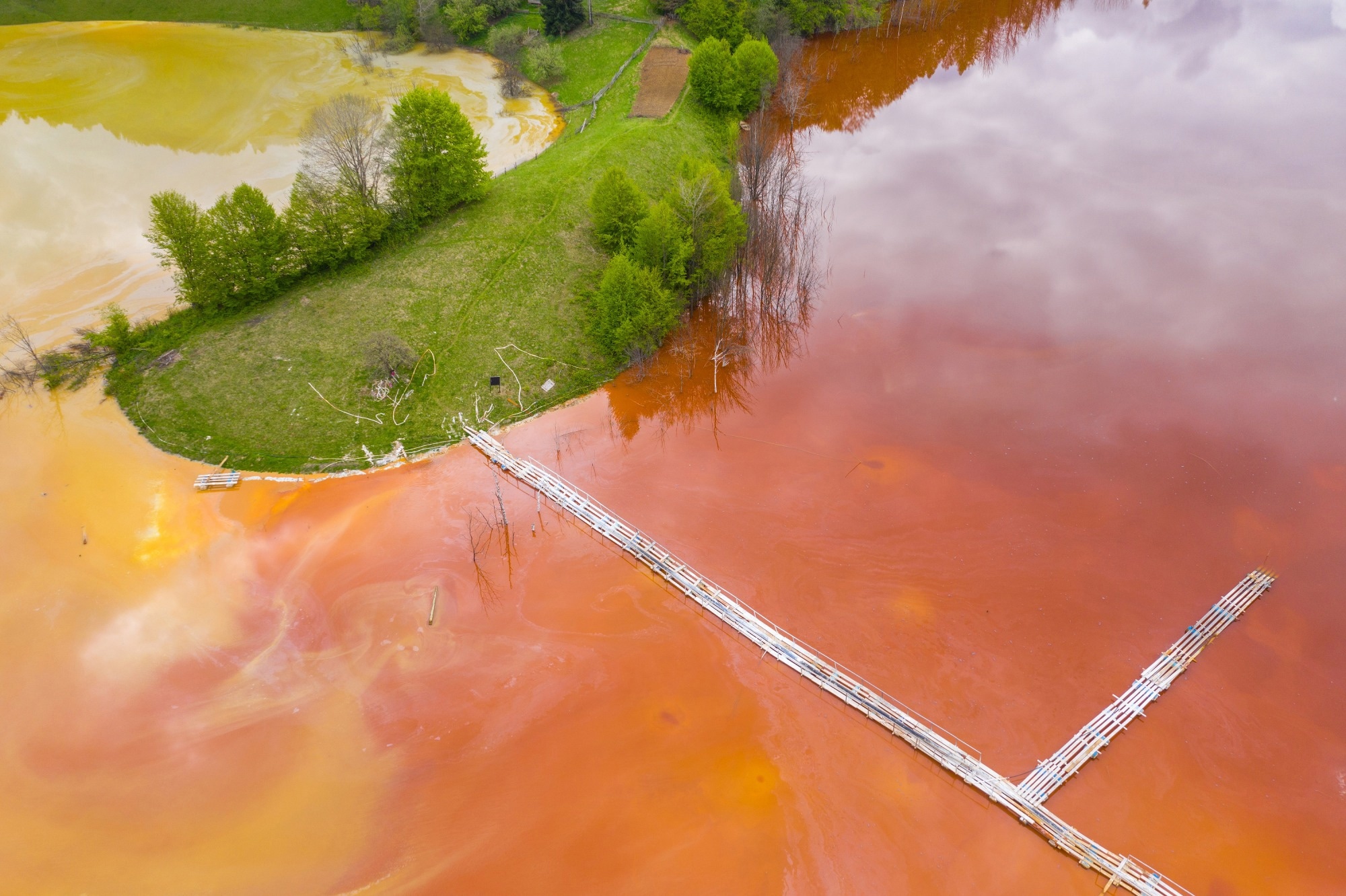 Image Credit: salajean/Shutterstock.com
How Acid Mine Drainage Forms: The Chemical Process and Primary Sources
AMD occurs when sulfur-bearing minerals, primarily pyrite and arsenopyrite, in exposed coal seams react with water and oxygen, producing sulfuric acid. This highly acidic water, often with a pH below 4, leaches heavy metals, including iron, aluminum, manganese, copper, lead, and zinc, from surrounding rock and soil, and contaminates nearby waterways.2
This chemical reaction intensifies dramatically in the presence of iron- and sulfur-oxidizing bacteria, such as Acidithiobacillus ferrooxidans, which thrive in the low-pH, oxygen-rich, iron-laden environments created by mining.3 As biological catalysts, these microorganisms accelerate metal-ion oxidation by several orders of magnitude.
Coal mining activities, whether underground, strip, or auger mining, expose sulfide minerals through blasting and dewatering, creating conditions conducive to AMD formation.
The AMD formation process typically begins when subsurface mining operations extending below the water table are abandoned. Active mines require continuous pumping to prevent flooding, but once pumping ceases, groundwater floods the underground workings, exposing sulfide minerals to the oxygen-rich water that triggers AMD formation.
Beyond flooded mine shafts, additional sources include coal spoil piles, waste rock dumps, tailings impoundments, and coal washing facilities where sulfur-bearing materials are disturbed and exposed.
The Environmental and Economic Toll of AMD
AMD poses one of the most severe environmental threats associated with coal mining, contaminating surface water and groundwater for decades or even centuries after mining operations cease.4
The scope of this problem is staggering: thousands of kilometers of streams worldwide are affected by AMD pollution, turning once-thriving waterways into toxic channels.
The aquatic ecosystems are among the most affected by AMD. Fish populations disappear, invertebrates die off, and entire food chains collapse.5 The visual evidence is unmistakable: contaminated streams run orange or rust-red, their beds coated with metal precipitates, supporting virtually no aquatic life.6
Beyond the ecological devastation, AMD creates significant regulatory and financial burdens. Mining companies face strict legal obligations under environmental protection laws, including requirements to treat all contaminated discharges before they enter natural waterways.
Treatment systems are technically complex and expensive to build and maintain, with costs varying widely depending on water chemistry, flow rates, and chosen remediation methods.
Governments and private operators worldwide spend millions annually to manage AMD, from constructing treatment facilities to monitoring water quality and maintaining long-term remediation systems. Even modest treatment projects can require substantial investments, making AMD management one of the mining industry’s most persistent and costly environmental challenges.7
Healing the Red Mo: The Toxic Legacy of Acid Mine Drainage | Red Moshannon Creek
Video Credit: wpsu/YouTube.com
AMD Management Strategies
Managing AMD requires two fundamental strategies: preventing AMD formation at its source and treating contaminated water already flowing from mine sites.1
The most cost-effective approach is to eliminate the conditions necessary for AMD formation. Since oxidation requires oxygen, water, and exposed sulfide minerals, prevention strategies focus on removing oxygen from the equation.
One proven method involves flooding abandoned mines with groundwater, displacing oxygen-rich air and halting the chemical reactions that generate acidity. This requires sealing all mine openings with impermeable grouting materials to prevent air infiltration.
Several materials, including flue gas desulfurization (FGD) byproducts from coal-fired power plants, have been identified as potential sealing agents.8 Calcium sulfate (gypsum), an FGD material, offers dual benefits: it seals mine openings while repurposing industrial waste. Alternatively, mines can be completely filled with solid materials, such as clay slurries or other industrial byproducts, physically blocking oxygen from contacting sulfide-bearing rock.
Where AMD already exists, effluent treatment is required to protect downstream ecosystems. Chemical treatment offers immediate results by neutralizing acidity with alkaline substances such as soda ash, lime, or sodium hydroxide.1 As pH rises, dissolved metals precipitate from solution and settle in sedimentation basins, where they can be removed. While highly effective, chemical treatment requires continuous inputs of materials, ongoing maintenance, and can be prohibitively expensive for long-term application, especially at remote sites.
Biological treatment offers a more sustainable alternative through engineered systems such as constructed wetlands.9 These systems mimic natural processes, using microbial activity and plant uptake to neutralize acidity and remove metals. Wetlands require less maintenance than chemical systems and have lower operating costs, though their effectiveness depends on climate, flow rates, and contamination levels.
Physical interventions complement other methods by strategically managing water flow. This includes rerouting streams away from contaminated areas, isolating problematic rock formations, or creating barriers to prevent clean water from entering AMD-generating zones.
Technological Advancements and Future Directions
Emerging research is expanding AMD management beyond traditional methods.
One innovative approach transforms AMD from a liability to a resource by extracting iron compounds for use in pigments and art materials, demonstrating that environmental remediation can generate economic value.10
Advanced monitoring technologies are improving treatment effectiveness through predictive modeling.11 By analyzing water quality parameters, flow rates, and water table measurements, researchers can forecast AMD behavior and design more targeted restoration strategies. Biological monitoring, such as tracking populations of fish, macroinvertebrates, and algae alongside habitat quality assessments, provides crucial feedback on treatment success and ecosystem recovery.5
Geographic information systems (GIS) now integrate these diverse data streams, creating comprehensive platforms for managing AMD information across entire watersheds.12 These systems help mining companies make better calls about where to put limited cleanup resources. All of these tech advances give real reason for optimism that AMD can be handled more effectively - and without breaking the bank - in the years ahead.
References and Further Reading
- Masindi V, et al. Challenges and avenues for acid mine drainage treatment, beneficiation, and valorisation in circular economy: A review. Ecol Eng. 2022; 183, 106740. https://doi.org/10.1016/j.ecoleng.2022.106740
- Yuan J, et al. Resource Utilization of Acid Mine Drainage (AMD): A Review. Water. 2022; 14(15):2385. https://doi.org/10.3390/w14152385
- Tonietti L, et al. Unveiling the Bioleaching Versatility of Acidithiobacillus ferrooxidans. Microorganisms. 2024; 12(12):2407. https://doi.org/10.3390/microorganisms12122407
- Wang Z, et al. Review: Acid Mine Drainage (AMD) in Abandoned Coal Mines of Shanxi, China. Water. 2021; 13(1):8. https://doi.org/10.3390/w13010008
- Herbst DB, et al. Long-term effects and recovery of streams from acid mine drainage and evaluation of toxic metal threshold ranges for macroinvertebrate community reassembly. Environ Toxicol Chem. 2018;37(10):2575-2592. doi: 10.1002/etc.4217.
- Why are Alaska’s rivers turning bright orange? Scientists have a theory. National Geographic. Available at: https://www.nationalgeographic.com/environment/article/alaska-orange-rivers-rusting
- Naidu G, et al. A critical review on remediation, reuse, and resource recovery from acid mine drainage. Env Pollut. 2019; 247, 1110-1124. https://doi.org/10.1016/j.envpol.2019.01.085
- Milak P, et al. Evaluation of Flue Gas Desulfurization (FGD) Waste Potentiality from Coal-Fired Power Plants to Obtain Alkali-Activated Materials. Minerals. 2025; 15(9):930. https://doi.org/10.3390/min15090930
- Pat-Espadas AM, et al. Review of Constructed Wetlands for Acid Mine Drainage Treatment. Water. 2018; 10(11):1685. https://doi.org/10.3390/w10111685
- Patel A, et al. Integrating biometallurgical recovery of metals with biogenic synthesis of nanoparticles. Chemosphere. 2021; 263, 128306. https://doi.org/10.1016/j.chemosphere.2020.128306
- Elghali A, et al. Prediction of acid mine drainage: Where we are. Earth-Science Reviews. 2024; 241, 104421. https://doi.org/10.1016/j.earscirev.2023.104421
- Khalil A, et al. GIS-based environmental database for assessing the mine pollution: A case study of an abandoned mine site in Morocco. J Geochem Explor. 2014; 144, 468-477. https://doi.org/10.1016/j.gexplo.2014.03.023
Disclaimer: The views expressed here are those of the author expressed in their private capacity and do not necessarily represent the views of AZoM.com Limited T/A AZoNetwork the owner and operator of this website. This disclaimer forms part of the Terms and conditions of use of this website.