A drone-mounted laser system is enabling high-density geochemical mapping of mining waste, offering a faster and more precise way to identify critical raw materials across complex terrains.
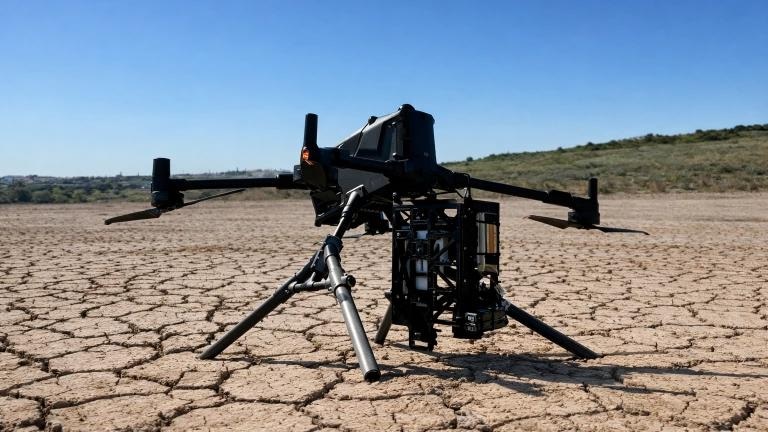
Image Credit: Chemocopter platform, REMINLASER project (University of Malaga & IGME-CSIC), https://chemocopter.com/home/reminlaser/
Researchers at the University of Malaga have developed REMINLASER, an airborne technology designed for high-resolution geochemical mapping. The system allows rapid assessment of mining waste and identification of critical raw materials (CRMs), which are essential for industries such as renewable energy, electronics, and aerospace.
As demand for these materials continues to rise, particularly within Europe’s energy and digital transition, REMINLASER offers a more efficient alternative to conventional assessment methods while supporting sustainable resource management.
Advancements in Remote Sensing Capabilities
REMINLASER was developed through collaboration between the Instrumentation for Extreme Environments group at the University of Malaga and the Geological and Mining Institute of Spain (IGME-CSIC). Building on earlier systems like the Chemocopter (a drone-compatible laser-based analytical platform), the new system extends geochemical screening capabilities across larger and more complex terrains.
At its core, REMINLASER uses a stand-off laser-based analytical technique. Laser pulses interact with surface materials, generating spectral signals that reveal elemental composition. These measurements are geo-referenced and collected via unmanned aerial platforms, enabling detailed chemical mapping without direct contact.
This airborne implementation represents a step forward in remote geochemical analysis. It enables high-resolution mapping at scales and speeds that were previously difficult to achieve, especially in hazardous or inaccessible environments. Compared to traditional sampling methods, the system improves both safety and efficiency while maintaining analytical depth.
Methodological Framework and Validation
The team designed REMINLASER as a fully operational UAV-mounted system for high-density geochemical screening. To ensure accuracy, they validated its performance through laboratory testing and comparisons with established techniques such as X-ray fluorescence (XRF) and inductively coupled plasma mass spectrometry (ICP-MS).
Field trials showed that the system can survey large areas quickly, making it well-suited for early-stage decision-making in mining operations. Alongside the hardware, the researchers developed an analytical framework that uses data-driven and multivariate methods to interpret complex datasets, which is particularly useful when dealing with heterogeneous materials where signals are not always straightforward.
This combination of hardware and analytics allows the system to fit into existing workflows without disruption, helping operators move efficiently from initial screening to targeted laboratory analysis. The project, supported by the Government of Andalusia, also aligns with wider European efforts to secure a stable and sustainable supply of critical raw materials.
Key Outcomes and Implications for Mining
The results highlight clear benefits for the mining sector. REMINLASER enables rapid, high-density screening of mining waste, helping identify areas with strong potential for CRM recovery.
Rather than replacing traditional lab analysis, it works as a first-step screening tool, narrowing down where to focus efforts. This not only improves efficiency but also reduces the need for extensive on-site sampling, which can be time-consuming and risky.
The system also supports the goals of the European Critical Raw Materials Act (CRMA), which aims to strengthen resource security and reduce reliance on external supply chains. Being able to identify valuable materials in mining waste is becoming increasingly important as global demand continues to rise.
Applications and Future Prospects
REMINLASER has clear potential across a range of mining applications. Its ability to quickly assess large areas makes it particularly useful for evaluating legacy mining sites and identifying secondary resource opportunities.
By making it easier to locate valuable materials in waste, the system offers a more environmentally responsible alternative to traditional exploration approaches. Its successful validation also suggests strong potential for scaling into real-world operations, and the research team is already exploring collaborations through European consortiums.
Conclusion
Overall, REMINLASER represents a meaningful step forward in how mining waste is assessed and how critical materials are identified. By combining drone mobility with laser-based analysis, it delivers faster insights, improves safety, and supports more sustainable resource use.
While some aspects of the methodology remain confidential, further validation and wider industry engagement will be important for broader adoption.
Disclaimer: The views expressed here are those of the author expressed in their private capacity and do not necessarily represent the views of AZoM.com Limited T/A AZoNetwork the owner and operator of this website. This disclaimer forms part of the Terms and conditions of use of this website.