Focus Graphite Inc. (“Focus”), a Canadian developer of high-grade flake graphite deposits and advanced graphite materials for battery, defense, and industrial applications, is pleased to announce its upgraded mineral resource estimate (“MRE”) on its 100 %-owned Lac Tetepisca Project in Quebec. The MRE was completed pursuant to the requirements of National Instrument 43-101 – Standards of Disclosure for Mineral Projects (“NI 43-101”).
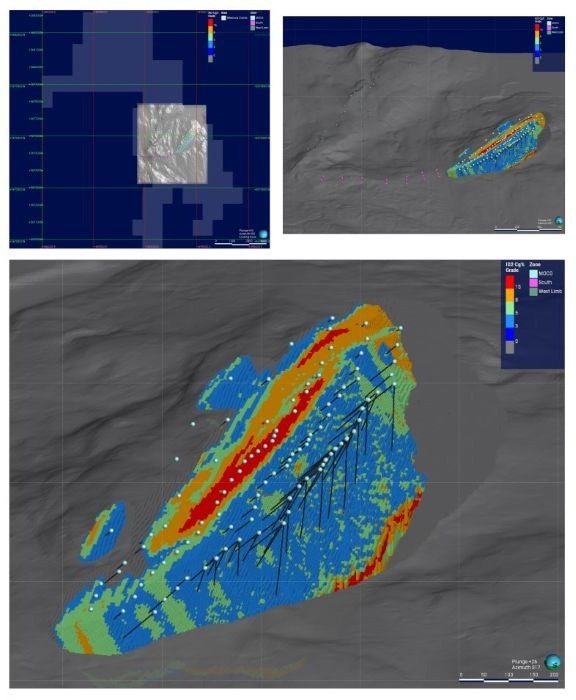 2026 MRE Resource Block model of the Lac Tetepisca Project. Image Credit: Focus Graphite Inc.
Highlights
- One of the Largest Identified Graphite Deposits Globally: This new mineral resource estimate includes 120,163 ktons of Indicated Mineral Resources at 10.27 % Cg and 24,143 ktons of Inferred Mineral Resources at 9.88 % Cg (see table below for additional details regarding the calculation of the MRE and the average Cg grades for the Indicated and Inferred Mineral Resources).
- High-Grade Mineral Resources: Estimates were calculated using a conservative 3.5 % Cg cut-off grade and a US$1,200 per ton average selling price for graphite concentrate.
- Significant Expansion Potential: Opportunities exist through step-out and infill drilling to extend the deposit to the southwest and at greater depths, as well as through drill testing of numerous additional geophysical anomalies.
- AI-Enabled Characterization Technology: Novel, low-cost AI-enabled in situ graphite flake characterization technology is expected to be incorporated into a future MOGC mineral resource update.
- Potential Acid generation Mitigation Materials: Dolomitic marble from the hanging wall has been included within the resource shell and may be used to mitigate acid generation within the tailings storage facility. Acid buffering capacity results are expected to be published in the coming months.
IOS Geosciences Inc. (“IOS”), a leading Quebec-based geological consulting firm was retained to produce a mineral resource estimate update and prepare a technical report (the “Technical Report”). The Technical Report will contain the full results of the Company’s drill program and a mineral resource estimation update. Pursuant to NI 43-101, the Company will file the Technical Report within forty-five (45) days of the date hereof on the Company’s SEDAR+ profile at http://www.sedarplus.ca.
The MRE update was completed by IOS, using results from 150 drill holes totaling 26,095 meters, and including 2022 campaign results recently reported and totaling 9,628 meters from 44 drill holes.
The MRE update for the Project is based on 150 inclined and sub-vertical diamond drill holes performed between 2014 and 2022 on the Manicouagan-Ouest Graphitic Corridor (“MOGC”) and South-West MOGC (“SW-MOGC”) graphite prospect, totaling of 26,095 meters. Focus discovered the MOGC prospect in July 2012 while conducting reconnaissance geological mapping, prospecting, and trenching on the Property. The MOGC is defined by a 2 kilometer linear Magnetic (MAG) and Electromagnetic (EM) anomaly that trends N035 °. Drilling was conducted on a 1.5 km long segment of the MOGC following 300 m long drilling lines oriented N305 ° and spaced 100 m, 50 m, or 25 m apart.
Table 1. Mineral Resources (at 3.5 % Cg Cut-Off) - MOGC, Lac Tetepisca Project
| Mineral Resource Category |
Tons (kt) |
Graphitic Carbon (%) |
In-Situ Graphite (kt) |
| Measured* |
- |
- |
- |
| Indicated* |
120,163 |
10.27 |
12,345 |
| Total Measured and Indicated* |
120,163 |
10.27 |
12,345 |
| Inferred* |
24,143 |
9.88 |
2,386 |
* See notes 1,2,3,4,5,6,7,8,9,10,11,12,13,14,15
Notes
- These mineral resources are not mineral reserves as they do not have demonstrated economic viability. The MRE follows current CIM Definition Standards (2014) and CIM MRMR Best Practice Guidelines (2019). A technical report supporting the MRE will be filed within 45 days in accordance with NI 43-101. The results are presented undiluted and are considered to have reasonable prospects for eventual economic extraction (“RPEEE”).
- The independent and qualified persons (“QPs”) for the mineral resource estimate, as defined in NI 43-101, are Jean-Michel Dubé, P.Geo. from IOS Geosciences and Alexandre Burelle, P.Eng., from Evomine Consulting. The effective date is April 30th, 2026.
- The estimate includes four (5) variably mineralized domains and one (1) dilution envelope modeled using LeapFrog Geo and interpolated using LeapFrog Edge.
- 0 m composites were calculated within the mineralized zones using the grade of the adjacent material when assayed or a value of zero when not assayed.
- High-grade capping on composites (supported by statistical analysis) was set at 27 % Cg in the MOGC zone and 8.5 % Cg in the SW-MOGC zone. Outlier capping restriction was set at 16 % Cg for composites in the MOGC zone that are situated further than 50 % the maximum interpolation distances.
- The estimate was completed using a rotated block model (N030 °) in Leapfrog Edge, with a parent block size of 5 m x 10 m x 5 m (X, Y, Z) and a sub-block size of 2.5 m x 5 m x 2.5 m (X, Y, Z).
- Grade interpolation was obtained by Inverse Distance Squared (ID2) methodology using hard boundaries.
- Density values are interpolated and blocks that are not interpolated were assigned their lithology average value.
- Mineral resources were classified as Indicated and Inferred. Indicated resources are defined with a minimum of three (3) drill holes in areas where the closest composite is situated less than 90 m away from the block centroid and Inferred resources with two (2) drill holes in areas where the closest composite is situated less than 135 m away from block centroids and there is reasonable geological and grade continuity.
- It is the QP’s opinion that the current classification used is adequate and reliable for this type of mineralization and mineral resource estimate.
- The MRE is pit constrained. There are no out-pit resources meeting the RPEEE requirement.
- The RPEEE requirement is satisfied by applying a cut-off grade based on reasonable economic parameters and constraining volumes. The potential open pit (OP) of the 2026 MRE is locally constrained by a surface optimized with the pseudo-flow algorithm in Deswik using a cut-off grade of 3.5 %Cg. The following parameters were considered: mining cost = CA$6.00/t mined; processing cost = CA$35.00/t processed; G&A cost = CA$10.00/t processed; concentrate transportation cost = CA$200/t conc.; Cg Price = US$1,200/t conc.; CAD/USD exchange rate = 1.38; overburden slope angle = 25 °; rock slope angle = 50 °; concentrator recovery = 86.6 %, concentrate grade = 96.4 %.
- The number of metric tons was rounded to the nearest thousand, following the recommendations in NI 43-101. The metal contents are presented in tons (tons x grade) rounded to the nearest thousand. Any discrepancies in the totals are due to rounding effects.
- The QPs are not aware of any known environmental, permitting, legal, title-related, taxation, socio-political, or marketing issues or any other relevant issue not reported in the Technical Report that could materially affect the Mineral Resources Estimate.
- No mineral reserves have been established for the Lac Tetepisca Project.
Table 2. Sensitivity Analysis
| |
Mineral Resource Category |
| |
Measured |
Indicated |
Inferred |
| Cut Off (Cg) |
Tons (kt) |
Graphitic Carbon (%) |
In-Situ Graphite (kt) |
Tons (kt) |
Graphitic Carbon (%) |
In-Situ Graphite (kt) |
Tons (kt) |
Graphitic Carbon (%) |
In-Situ Graphite (kt) |
Base Cas
3.5 % |
- |
- |
- |
120,163 |
10.27 |
12,345 |
24,143 |
9.88 |
2,386 |
| 7.0 % |
- |
- |
- |
81,026 |
12.64 |
10,243 |
16,775 |
11.85 |
1,987 |
| 10.0 % |
- |
- |
- |
54,656 |
14.70 |
8,037 |
10,554 |
13.87 |
1,464 |
| 13.0 % |
- |
- |
- |
35,627 |
16.46 |
5,864 |
5,999 |
15.78 |
946 |
“This updated mineral resource at Lac Tetepisca represents a transformative milestone for Focus Graphite,” commented Dean Hanisch, Chief Executive Officer of Focus Graphite. “To be a credible and serious alternative source of supply to China, particularly in building a secure domestic North American supply chain, projects must demonstrate scale, size, and grade. Lac Tetepisca delivers on all three. While operating costs in Canada are inherently higher than in China, grade is the key equalizer, and the grade and scale we are demonstrating here are critical differentiators. Graphite is an industrial mineral, and qualifying a new supply requires significant time and effort to fully characterize the material, making switching unattractive. This is why deposits of this scale are generational, and we believe Lac Tetepisca’s size and grade justify that transition while reinforcing our position as a long-term North American supplier.”
Jason Latkowcer, Vice President of Corporate Development, commented, “Supply chains are being redefined by control and reliability. With Lac Knife and Lac Tetepisca, we are building a domestic platform capable of delivering high-grade graphite at scale, aligned with North American and allied energy and defense priorities.”
Qualified Person
The technical content disclosed in this news release was reviewed and approved by Rejean Girard, P.Geo (Qc), President of IOS Geosciences Inc., a consultant to the Company, and a qualified person as defined under National Instrument NI 43-101.
Data Verification
Vast majority of raw data, including drilling and assaying, were available to the author as a coherent and validated database, built and maintained by the contractor through the years. Rigorous logging and assaying procedure were maintained throughout all the drill programs. Data used for the current MRE have undergone a comprehensive verification process to ensure accuracy and reliability. The verification procedures were conducted by qualified professionals with relevant expertise in geological and mining disciplines. They were overseen by the Qualified Person.
QA/QC Procedures
Identical assaying procedure as well as Quality assurance and quality control (QA/QC) procedures were maintained throughout the various drill programs, in coherence with the Lac Knife sister project. Thorough laboratory proficiency analyzes were conducted in 2010-2012 on Lac Knife samples, and internal reference material was then manufactured and used throughout both Lac Knife and Lac Tetepisca QAQC programs. During 2012, 2014, 2018 and apart of 2021 program, COREM laboratory from Québec City has been used for routine assays. Activation Laboratories from Ancaster, ON, was used on 10 % interlaboratory for cross-checks purpose. For half of 2021 samples, these two laboratories’ roles were inverted. Aside of inter-laboratories duplicates, certified reference materials, internal reference materials and blanks were regularly inserted, and used to monitor result accuracy and precision. Total carbon, organic carbon and inorganic carbon analysis were performed on 10 % of the samples, certifying that the routine assays were only reporting graphitic carbon. The same 10 % of samples were also submitted for trace metal analysis, in anticipation of future environmental studies. They were subjected to their own QA/QC procedure. Re-assays and validation analysis were requested whenever deviations were noted.
MRE Validation
Multiple validation approaches were taken. Block volume estimates for each mineralized zone were compared to the 3D wireframe models. Block grades, composite grades and assays were visually compared on sections, plans and longitudinal views for both densely and sparsely drilled areas and no significant differences were observed. There is a good match observed in the grade distribution. The trend and local variation of the estimated inverse distance squared (ID2) interpolation were compared to ordinary kriging (OK) and nearest-neighbor (NN) interpolation using swath plots (North, East, Elevation, Northeast).
Geological Complexity
The property’s geological setting is quite simple but may still pose challenges in terms of interpretation and validation. Unknown geological structures and mineralization patterns could introduce uncertainties despite validation efforts.
It is crucial to note that, despite these limitations, every effort has been made to minimize potential biases and inaccuracies in the data. Qualified Persons have exercised their professional judgment to mitigate these limitations and ensure the reliability of the information presented in this report.