* Important notice: This news reports on an unedited version of an accepted paper and is awaiting final editing. Therefore, the paper should not be regarded as conclusive or treated as established information.
A mixed-integer non-linear programming model has been developed, which integrates environmental costs, government royalties, and operational penalties into long-term production scheduling for open-pit copper (Cu) mining. This approach demonstrates more realistic and responsible mine planning compared to conventional methods. The findings, based on work conducted at the Kal-e Kafi copper deposit in Iran, were published in Scientific Reports.
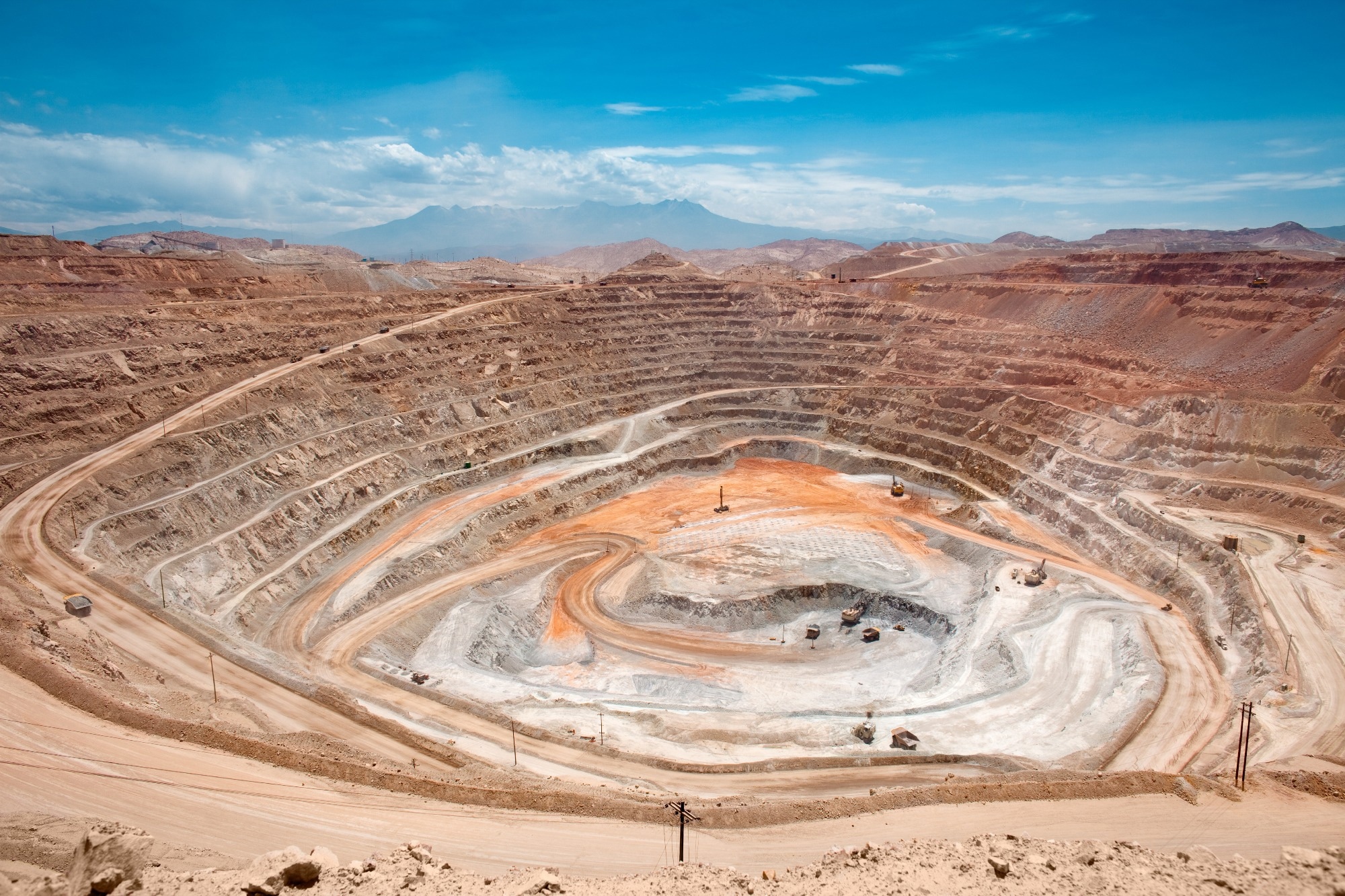 Study: Responsible optimization of long-term production scheduling in open-pit mines. Image Credit: Jose Luis Stephens/Shutterstock.com
Responsible Mine Planning Rationale
Open-pit mining is the dominant method for extracting near-surface minerals, such as copper, with a focus on maximizing net present value (NPV) through careful pit design and extraction sequencing. Conventional scheduling models emphasize economic returns but often omit critical factors such as environmental costs, government royalties, and penalties for operational deviations.
This oversight results in plans that are economically optimistic but lack practical feasibility and sustainability. Long-term mine planning is further complicated by uncertainties in commodity prices and geology, requiring frequent updates to maintain viability. Most commercial scheduling software externalizes environmental and regulatory costs, leading to inflated project valuations and a disconnect between theoretical models and real-world conditions.
With increasing emphasis on environmental, social, and governance (ESG) criteria and stricter regulations, integrating these costs into production schedules is essential. This study addresses this gap by developing an optimization framework for the Kal-e Kafi copper deposit that incorporates environmental and regulatory costs, thereby promoting responsible and sustainable mining planning.
Saving this for later? Download now.
MINLP Model Formulation and Solution
The study employs a mixed-integer non-linear programming (MINLP) model, customized to integrate long-term production scheduling for an open-pit copper mine. The model explicitly integrates environmental impacts, government royalty obligations, and penalties for deviations from prescribed mill feed tonnage and ore grade into both the objective function and the block economic value (BEV) estimation.
The Kal-e Kafi block model, comprising 20,746 selective mining units with detailed geological and economic parameters, serves as the testbed. The environmental costs are quantified through a novel, deposit-specific, multi-stage methodology that accounts for the human development index, mine scale, location, mining method, mineral type, and ecosystem sensitivity, moving beyond the generic assumptions seen in prior literature.
Operational constraints embedded in the mathematical model encompass extraction capacity, processing capacity, grade blending, clay content, and semi-autogenous grinding work index (SPI). These constraints ensure the feasibility of the production schedule under realistic mining and processing limitations.
Notably, the model integrates the strategic determination of the ultimate pit limit (UPL) into annual production planning, considering slope stability, blending criteria, and capacity constraints within a unified framework.
To address the computational challenge posed by the large-scale optimization problem, the study applies a divide-and-conquer preprocessing heuristic paired with the BARON 23.1.7 global solver. This approach balances solution accuracy and computational feasibility, yielding solutions within a reasonable timeframe of approximately eight hours.
The model's performance is benchmarked against the industry-standard datamine NPV scheduler, using identical input data, to quantify the effects and trade-offs of explicitly including environmental and regulatory costs relative to conventional approaches.
Kal-e Kafi Scheduling Outcomes
The MINLP model applied to the Kal-e Kafi copper deposit yielded a net present value (NPV) of $129.34 million, a stripping ratio of 0.64:1, a 14-year mine life, and 14.24 million tons of mineable ore at a 0.12% cutoff grade.
Although datamine software reported a higher nominal NPV of $132.7 million, it excluded high costs, including environmental fees ($0.02927 per ton), government royalties ($0.8/kg copper), and penalties for tonnage and grade deviations, resulting in an incomplete economic assessment.
By internalizing these costs, the MINLP model delivered a more conservative yet operationally feasible and sustainable plan. It extended mine life by one year, reduced the stripping ratio by 15.8%, and increased extractable ore tonnage by 2.1%, demonstrating enhanced operational efficiency through optimized trade-offs between ore extraction and long-term costs.
The model consistently met the targeted mill feed tonnage and grade, stabilizing processing by incorporating penalty costs and enforcing constraints on blend quality and grindability. Sensitivity analysis confirmed robustness, revealing copper price as the dominant factor (elasticity 1.69), with negligible sensitivity to environmental costs (−0.01). This suggests that sustainability integration does not compromise profitability.
This comprehensive approach aligns scheduling with responsible mining and regulatory compliance, surpassing traditional methods while highlighting areas for future improvement, including stochastic modeling and computational efficiency enhancements.
Sustainable Mining Insights and the Future
This study demonstrates that responsible mining can align with economic goals by integrating environmental costs, royalties, and operational penalties into a unified long-term scheduling framework. The customized MINLP model applied to the Kal-e Kafi copper deposit delivered an operationally feasible, environmentally responsible, and economically sound mine plan.
Its lower nominal NPV relative to conventional software reflects a conservative, realistic economic evaluation that includes the typically excluded real-world costs. Superior operational metrics, reduced stripping ratio, extended mine life, and increased recoverable ore underscore its practical advantages. Sensitivity analysis confirms robustness and shows that the internalization of environmental costs does not harm competitiveness.
The findings guide mine planners, policymakers, and educators toward sustainable investment and regulation, establishing a rigorous paradigm for responsible open-pit scheduling. The researchers suggest that future research should focus on stochastic optimization and computational improvements for larger deposits.
Journal Reference
Badakhshan N., Afraei S., et al. (2026). Responsible optimization of long-term production scheduling in open-pit mines. Scientific Reports. https://www.nature.com/articles/s41598-026-55975-y