Resolution Minerals has reported three gold drill intersections of more than 230 meters at its Horse Heaven project in Idaho, strengthening evidence that higher-grade gold forms a continuous zone and supporting work towards a first mineral resource estimate.
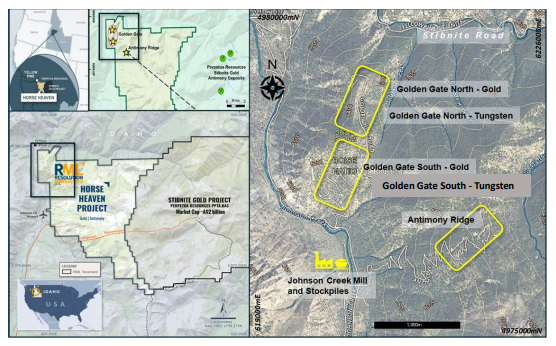 Resolution's Horse Heaven Antimony-Tungsten-Gold-Silver Project. Image Credit: Resolution Minerals
The three holes tested ground between earlier gold intersections at Golden Gate North. The results help define the higher-grade core within a mineralized zone that stretches about 500 meters and has an estimated true width of about 200 meters. Drilling has yet to define its limits to the northeast, southwest and at depth.
The longest new intersection ran 272.2 meters from surface and averaged 0.55 grams of gold per ton. A second hole returned 264.9 meters at 0.59 grams per ton from surface, including 18.7 meters at 2.19 grams per ton. Those lengths are measured along the drill holes.
Craig Lindsay, Resolution’s CEO of US Operations, said: “The assay results continue to strengthen the case for a major zone of gold mineralization at the Golden Gate North deposit. Increasingly, we are seeing the characteristics of reduced intrusive related gold deposits at Golden Gate. This aligns with our long held view that the neighboring Stibnite deposit is a valid analogue for Golden Gate North, Golden Gate South and Antimony Ridge, as related components of a single large mineralized system.”
Results are pending for 30 of the 42 holes drilled across Golden Gate North and South in 2026. Resolution plans to report tungsten assays separately and use the remaining drill results to build an initial mineral resource model. The company expects to release the results of that work in the first quarter of 2027, subject to completing the analysis.
Permitting is under way for the planned 2027 exploration program, which includes drilling to test the two-kilometer corridor between Golden Gate North and South and the first drilling at Antimony Ridge.