Austral Resources has intersected 14 meters grading 3.00% copper in the first results from its 2026 drilling at Enterprise, as the company tests where higher-grade copper continues and whether the deposit extends beyond its current resource.
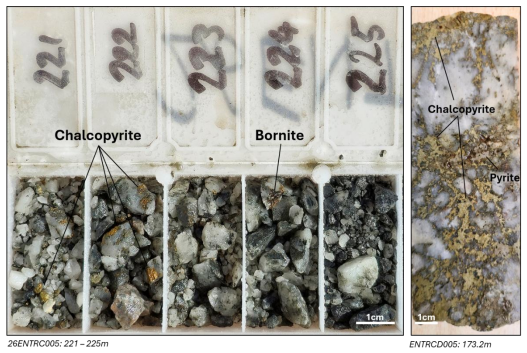 Chalcopyrite-bornite-pyrite mineralization observed in 26ENTRC005 (221-225 m), compared with chalcopyrite-pyrite mineralization from historical drillhole ENTRCD005 (173.2 m). Image Credit: Austral Resources Australia Ltd
The interval began at 118 meters downhole and included 11 meters at 3.70% copper. A separate hole intersected several zones of copper sulfides, including 27 meters at 1.21% copper from 151 meters and 13 meters at 1.73% from 228 meters. Austral estimates true widths at about 60% of the reported drill lengths, with local variation.
Enterprise has an existing inferred mineral resource of 950,000 tons at 0.97% copper, using a 0.5% copper cut-off. Historical drilling for that estimate covered nearly 800 meters along the deposit, with drill sections about 120 to 125 meters apart. The drilling program aims to establish how consistently copper grades carry between those sections.
The deeper sulfide intersections support Austral’s interpretation of where higher-grade copper may continue at depth. Surface sampling also identified elevated copper levels along about two kilometers, and Austral has yet to test that full length.
Austral Resources Chairman David Newling said:
"Enterprise is the latest in a strong run of results from our exploration team this year. It points to real upside not only at Enterprise but across AR's broader 5,000 km2 of tenure, which anchors our organic growth strategy. Taken together, Snow Queen, McLeod Hill, Canyon, Waterhole and now Enterprise show a clear development pathway for the Company as it works towards becoming Australia's next mid-tier copper powerhouse."
Austral plans a further 17 holes to test deeper, higher-grade targets and extensions beyond the existing resource. It will report assay results progressively after validation. The company also plans preliminary tests to assess how near-surface material might respond to processing and will use the new drilling and density measurements to update its resource model.